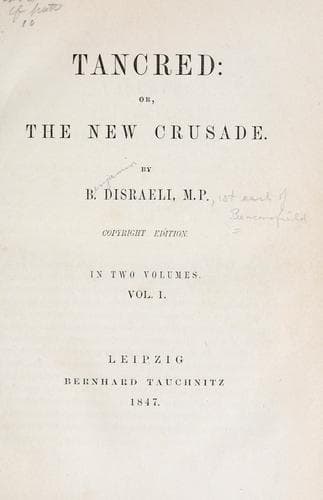
Tancred; Or, The New CrusadeDisraeli, Benjamin, Earl of Beaconsfield
ReligionJewish
Tancred; Or, The New Crusade
Disraeli, Benjamin, Earl of Beaconsfield
Christianity and other religions -- Judaism -- Fiction; Judaism -- Relations -- Christianity -- Fiction
Though London is vast, it is very monotonous. All those new districts
that have sprung up within the last half-century, the creatures of our
commercial and colonial wealth, it is impossible to conceive anything
more tame, more insipid, more uniform. Pancras is like Mary-le-bone,
Mary-le-bone is like Paddington; all the streets resemble each other,
you must read the names of the squares before you venture to knock at
a door. This amount of building capital ought to have produced a great
city. What an opportunity for architecture suddenly summoned to furnish
habitations for a population equal to that of the city of Bruxelles,
and a population, too, of great wealth. Mary-le-bone alone ought to have
produced a revolution in our domestic architecture. It did nothing. It
was built by Act of Parliament. Parliament prescribed even a façade. It
is Parliament to whom we are indebted for your Gloucester Places, and
Baker Streets, and Harley Streets, and Wimpole Streets, and all those
flat, dull, spiritless streets, resembling each other like a large
family of plain children, with Portland Place and Portman Square for
their respectable parents. The influence of our Parliamentary Government
upon the fine arts is a subject worth pursuing. The power that produced
Baker Street as a model for street architecture in its celebrated
Building Act, is the power that prevented Whitehall from being
completed, and which sold to foreigners all the pictures which the King
of England had collected to civilise his people.
In our own days we have witnessed the rapid creation of a new
metropolitan quarter, built solely for the aristocracy by an aristocrat.
The Belgrave district is as monotonous as Mary-le-bone; and is so
contrived as to be at the same time insipid and tawdry.
Where London becomes more interesting is Charing Cross. Looking to
Northumberland House, and turning your back upon Trafalgar Square, the
Strand is perhaps the finest street in Europe, blending the architecture
of many periods; and its river ways are a peculiar feature and rich with
associations. Fleet Street, with its Temple, is not unworthy of being
contiguous to the Strand. The fire of London has deprived us of the
delight of a real old quarter of the city; but some bits remain, and
everywhere there is a stirring multitude, and a great crush and crash of
carts and wains. The Inns of Court, and the quarters in the vicinity of
the port, Thames Street, Tower Hill, Billingsgate, Wapping, Rotherhithe,
are the best parts of London; they are full of character: the buildings
bear a nearer relation to what the people are doing than in the more
polished quarters.
Public-domain text, read in full here on John Shaqi.
Reviews
Reviews
No reviews yet
Be the first to share your thoughts on this work.
Elsewhere in the archive
Join the Discussion
Join the discussion
Sign in to leave a comment or review.
Sign InorCreate an account