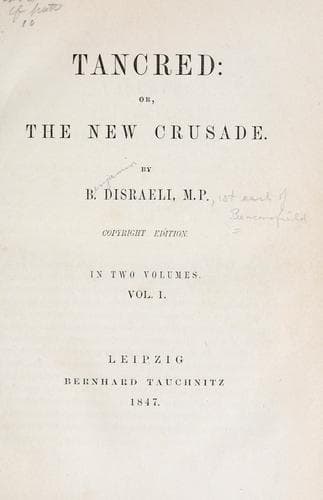
Tancred; Or, The New CrusadeDisraeli, Benjamin, Earl of Beaconsfield
ReligionJewish
Tancred; Or, The New Crusade
Disraeli, Benjamin, Earl of Beaconsfield
Christianity and other religions -- Judaism -- Fiction; Judaism -- Relations -- Christianity -- Fiction
The old merchants of the times of the first Georges were a fine race.
They knew their position, and built up to it. While the territorial
aristocracy, pulling down their family hotels, were raising vulgar
streets and squares upon their site, and occupying themselves one of
the new tenements, the old merchants filled the straggling lanes, which
connected the Royal Exchange with the port of London, with mansions
which, if not exactly equal to the palaces of stately Venice, might at
least vie with many of the hotels of old Paris. Some of these,
though the great majority have been broken up into chambers and
counting-houses, still remain intact.
In a long, dark, narrow, crooked street, which is still called a lane,
and which runs from the south side of the street of the Lombards towards
the river, there is one of these old houses of a century past, and
which, both in its original design and present condition, is a noble
specimen of its order. A pair of massy iron gates, of elaborate
workmanship, separate the street from its spacious and airy court-yard,
which is formed on either side by a wing of the mansion, itself a
building of deep red brick, with a pediment, and pilasters, and copings
of stone. A flight of steps leads to the lofty and central doorway; in
the middle of the court there is a garden plot, inclosing a fountain,
and a fine plane tree.
The stillness, doubly effective after the tumult just quitted, the
lulling voice of the water, the soothing aspect of the quivering
foliage, the noble building, and the cool and capacious quadrangle, the
aspect even of those who enter, and frequently enter, the precinct, and
who are generally young men, gliding in and out, earnest and full
of thought, all contribute to give to this locality something of the
classic repose of a college, instead of a place agitated with the
most urgent interests of the current hour; a place that deals with the
fortunes of kings and empires, and regulates the most important affairs
of nations, for it is the counting-house in the greatest of modern
cities of the most celebrated of modern financiers.
It was the visit of Tancred to the City, on the Wednesday morning after
he had met Lord Eskdale, that occasions me to touch on some of the
characteristics of our capital. It was the first time that Tancred had
ever been in the City proper, and it greatly interested him. His visit
was prompted by receiving, early on Wednesday morning, the following
letter:
Public-domain text, read in full here on John Shaqi.
Reviews
Reviews
No reviews yet
Be the first to share your thoughts on this work.
Elsewhere in the archive
Join the Discussion
Join the discussion
Sign in to leave a comment or review.
Sign InorCreate an account