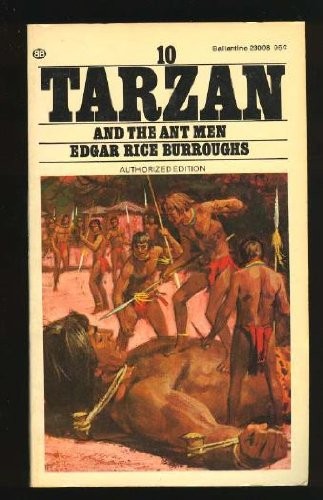
Adventure stories; Fantasy fiction; Tarzan (Fictitious character) -- Fiction
The girl who had started the pounding upon the wall suddenly stopped
and pointed at Tarzan. The others looked at him and then back at her,
whereupon she pointed at her bludgeon and then at Tarzan again, after
which she acted out a little pantomime, very quickly, very briefly,
but none the less realistically. The pantomime depicted the bludgeon
falling upon Tarzan's head, following which the pantomimist, assisted
by her fellows, devoured the ape-man. The bludgeons ceased to fall
upon the wall; the heels no longer smote the earth; the assemblage was
interested in the new suggestion. They eyed Tarzan hungrily. The mother
who should have brought them food, The First Woman, was dead. They
did not know this; all they knew was that they were hungry and that
The First Woman had brought them no food since the day before. They
were not cannibals. Only in the last stages of hunger, would they have
devoured one another, even as ship-wrecked sailors of civilized races
have been known to do; but they did not look upon the stranger as one
of their own kind. He was as unlike them as some of the other creatures
that The First Woman had brought them to feed upon. It was no more
wrong to devour him than it would have been to devour an antelope. The
thought, however, would not have occurred to most of them; the older
girl it was who had suggested it to them, nor would it have occurred
to her had there been other food, for she knew that he had not been
brought here for that purpose--he had been brought as the mate of The
First Woman, who in common with the other women of this primitive race
hunted a new mate each season among the forests and the jungles where
the timid males lived their solitary lives except for the brief weeks
that they were held captive in the stone corrals of the dominant sex,
and where they were treated with great brutality and contempt even by
the children of their temporary spouses.
Sometimes they managed to escape, though rarely, but eventually they
were turned loose, since it was easier to hunt a new one the following
season than to feed one in captivity for a whole year. There was
nothing approximating love in the family relations of these savage
half-brutes. The young, conceived without love, knowing not their own
fathers, possessed not even an elemental affection for one another, nor
for any other living thing. A certain tie bound them to their savage
mothers, at whose breasts they suckled for a few short months and to
whom they looked for food until they were sufficiently developed to
go forth into the forests and make their own kills or secure whatever
other food bountiful Nature provided for them.
Public-domain text, read in full here on John Shaqi.
Reviews
Reviews
No reviews yet
Be the first to share your thoughts on this work.
Join the Discussion
Join the discussion
Sign in to leave a comment or review.
Sign InorCreate an account