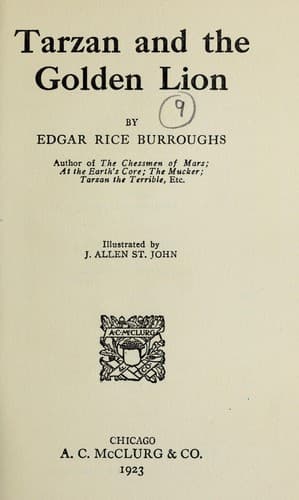
Adventure stories; Fantasy fiction; Tarzan (Fictitious character) -- Fiction
And so it befell that Tarzan of the Apes set out once more upon the long
trail that leads to Opar. Behind him marched fifty giant Waziri, the
pick of the warlike tribe that had adopted Tarzan as its Chief. Upon the
veranda of the bungalow stood Jane and Korak waving their adieux, while
from the rear of the building there came to the ape-man’s ears the
rumbling roar of Jad-bal-ja, the golden lion. And as they marched away
the voice of Numa accompanied them out upon the rolling plain, until at
last it trailed off to nothingness in the distance.
His speed determined by that of the slowest of the blacks, Tarzan made
but comparatively rapid progress. Opar lay a good twenty-five days’ trek
from the farm for men traveling light, as were these, but upon the
return journey, laden as they would be with the ingots of gold, their
progress would be slower. And because of this the ape-man had allotted
two months for the venture. His safari, consisting of seasoned warriors
only, permitted of really rapid progress. They carried no supplies, for
they were all hunters and were moving through a country in which game
was abundant—no need then for burdening themselves with the cumbersome
impedimenta of white huntsmen.
A thorn boma and a few leaves furnished their shelter for the night,
while spears and arrows and the powers of their great white chief
insured that their bellies would never go empty. With the picked men
that he had brought with him Tarzan expected to make the trip to Opar in
twenty-one days, though had he been traveling alone he would have moved
two or three times as fast, since, when Tarzan elected to travel with
speed, he fairly flew through the jungle, equally at home in it by day
or by night and practically tireless.
It was a mid-afternoon the third week of the march that Tarzan, ranging
far ahead of his blacks in search of game, came suddenly upon the
carcass of Bara, the deer, a feathered arrow protruding from its flank.
It was evident that Bara had been wounded at some little distance from
where it had lain down to die, for the location of the missile indicated
that the wound could not have caused immediate death. But what
particularly caught the attention of the ape-man, even before he had
come close enough to make a minute examination, was the design of the
arrow, and immediately he withdrew it from the body of the deer he knew
it for what it was, and was filled with such wonderment as might come to
you or to me were we to see a native Swazi headdress upon Broadway or
the Strand, for the arrow was precisely such as one may purchase in most
any sporting-goods house in any large city of the world—such an arrow
as is sold and used for archery practice in the parks and suburbs.
Nothing could have been more incongruous than this silly toy in the
heart of savage Africa, and yet that it had done its work effectively
was evident by the dead body of Bara, though the ape-man guessed that
the shaft had been sped by no practiced, savage hand.
Public-domain text, read in full here on John Shaqi.
Reviews
Reviews
No reviews yet
Be the first to share your thoughts on this work.
Join the Discussion
Join the discussion
Sign in to leave a comment or review.
Sign InorCreate an account