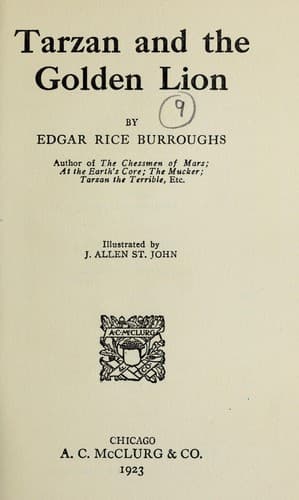
Adventure stories; Fantasy fiction; Tarzan (Fictitious character) -- Fiction
They named the lion Jad-bal-ja, which in the language of the
pithecanthropi of Pal-ul-don, means the Golden Lion, because of his
color. Every day he became more accustomed to them and to his foster
mother, who finally came to accept him as flesh of her flesh. The bitch
they called Za, meaning girl. The second day they removed her leash and
she followed them willingly through the jungle, nor ever after did she
seek to leave them, nor was happy unless she was near one of the three.
As the moment approached when the trail should break from the jungle
onto the edge of the rolling plain where their home had been, the three
were filled with suppressed excitement, though none uttered a syllable
of the hope and fear that was in the heart of each. What would they
find? What _could_ they find other than the same tangled mass of
vegetation that the ape-man had cleared away to build his home when
first he had come there with his bride?
At last they stepped from the concealing verdure of the forest to look
out across the plain where, in the distance, the outlines of the
bungalow had once been clearly discernible nestled amidst the trees and
shrubs that had been retained or imported to beautify the grounds.
“Look!” cried Lady Jane. “It is there—it is still there!”
“But what are those other things to the left, beyond it?” asked Korak.
“They are the huts of natives,” replied Tarzan.
“The fields are being cultivated!” exclaimed the woman.
“And some of the outbuildings have been rebuilt,” said Tarzan. “It can
mean but one thing—the Waziri have come back from the war—my faithful
Waziri. They have restored what the Hun destroyed and are watching over
our home until we return.”
[Illustration: He caught the little lion by the scruff of its neck]
CHAPTER II
THE TRAINING OF JAD-BAL-JA
AND so Tarzan of the Apes, and Jane Clayton, and Korak came home after a
long absence and with them came Jad-bal-ja, the golden lion, and Za, the
bitch. Among the first to meet them and to welcome them home was old
Muviro, father of Wasimbu, who had given his life in defense of the home
and wife of the ape-man.
“Ah, Bwana,” cried the faithful black, “my old eyes are made young again
by the sight of you. It has been long that you have been gone, but
though many doubted that you would return, old Muviro knew that the
great world held nothing that might overcome his master. And so he knew,
too, that his master would return to the home of his love and the land
where his faithful Waziri awaited him; but that she, whom we have
mourned as dead, should have returned is beyond belief, and great shall
be the rejoicing in the huts of the Waziri tonight. And the earth shall
tremble to the dancing feet of the warriors and the heavens ring with
the glad cries of their women, since the three they love most on earth
have come back to them.”
Public-domain text, read in full here on John Shaqi.
Reviews
Reviews
No reviews yet
Be the first to share your thoughts on this work.
Join the Discussion
Join the discussion
Sign in to leave a comment or review.
Sign InorCreate an account