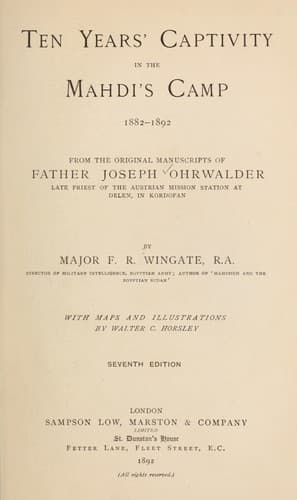
Ten Years' Captivity in the Mahdi's Camp 1882-1892Ohrwalder, Josef
Religion
Ten Years' Captivity in the Mahdi's Camp 1882-1892
Ohrwalder, Josef
Mahdi, Muhammad Ahmad, 1848-1885; Sudan -- History
Should the dispute be of a very serious nature, it is brought before
the high court at the Bab el Khalifa; but here money plays even a more
important part than in the smaller court. The success or failure of the
case depends on the ability with which the opposing mediators influence
the judgment; a hint or a sign with the hand is quite sufficient to make
the judge understand, and with marvellous astuteness he will contrive to
give the case an entirely new aspect, and one which, probably, only a
few moments before he has most strongly condemned, but which now he
thinks it advisable, under the circumstances, to adopt; and this change
of front is carried out without the smallest hesitation.
I will here give an example of what is considered justice in Omdurman. A
female slave who had for a long time had a quarrel with her mistress
decided to have her revenge, and the fact that her mistress was in the
habit of smoking and wearing jewels aided her in her design. She took
her lady's tobacco and cigarette papers, which were generally kept
hidden under ground, tied them in a little bundle, ran off with them to
a soldier who was her relative, and who belonged to Yakub's bodyguard,
and reported her mistress's evil doings.
Meanwhile the lady, finding that her slave had run away, sent her
brother-in-law in search of her. The family were now thoroughly
disturbed, and anticipated all sorts of bad consequences. The lady's
husband hastened to Yakub's house, thinking that perhaps the slave might
have gone there, and there, sure enough, he found her, surrounded by a
crowd of Ansar. The latter, espying Ahmed (as we may call him),
surrounded him and were carrying him before Yakub, when Ahmed, who did
not lose his head, explained to the Ansar that he had always been under
the impression that the Khalifa had appointed a judge to inquire into
all such matters, and that he was ready to bow to the judge's decision;
so he, the female slave, and the Ansar all went to the court. The slave
produced from her pocket the bundle, laid it before the Kadi, and then
stated her complaint against her mistress.
Meanwhile Ahmed had met a friend, and told him how that for a long time
the slave had been on bad terms with her mistress, and had seized this
opportunity for revenging herself on her, adding that she had probably
obtained the tobacco and cigarette papers from elsewhere, and had
trumped up this case to harm her mistress, who had never smoked in her
life nor worn jewels; indeed, if they liked they might go and inspect
the house.
The mediator gave a sign to the judge, who at once decided the case in
Ahmed's favour, and ordered him to go to the sheikh es suk, who had been
instructed to send some one to inspect his house.
Public-domain text, read in full here on John Shaqi.
Reviews
Reviews
No reviews yet
Be the first to share your thoughts on this work.
Elsewhere in the archive
Join the Discussion
Join the discussion
Sign in to leave a comment or review.
Sign InorCreate an account