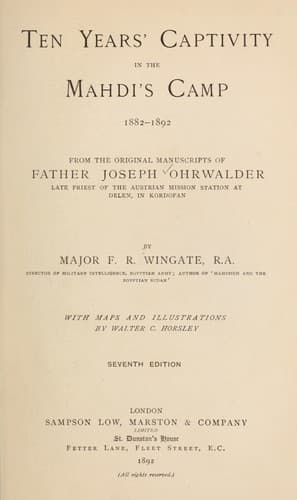
Ten Years' Captivity in the Mahdi's Camp 1882-1892Ohrwalder, Josef
Religion
Ten Years' Captivity in the Mahdi's Camp 1882-1892
Ohrwalder, Josef
Mahdi, Muhammad Ahmad, 1848-1885; Sudan -- History
It was not a difficult matter to circumvent the sheikh es suk, and when
they all arrived at the house, the slave was called upon to show the
place in which she had been ordered to hide her mistress's tobacco.
Without a moment's hesitation the slave came forward and began scraping
away the earth in a corner. It was evident that she had often done this
before, and that the hiding-place had been carefully prepared--indeed,
the slave found some tobacco still there which she had not noticed
before, and this she exultingly produced; but at that instant one of the
Ansar gave her a slap on the face, saying, "Look at this bint el kelb
(daughter of a dog), she brought some tobacco here which she purposely
dropped into the hole whilst she was clearing the earth away." Heaped
with insults by the bystanders, the poor slave was dragged off to the
market-place, where she received eighty lashes because she had failed to
prove the truth of her assertion. Such is Omdurman justice.
Although this is but one amongst thousands of cases of the most
disgraceful corruption, still all this serves to keep the slaves in
order, and were it not so, there is little doubt that masters would
stand in constant danger, and would be at the mercy of their slaves.
Indeed, many slaves have succeeded in getting their masters into great
disfavour by informing on them, and this makes the masters in great fear
of their slaves Even if a slave has been born and brought up in his
master's house he cannot be trusted, and if he receive some slight
punishment, it is more than probable he will go off and report his
master as a smoker, marissa-drinker, or that he has become lax in the
cause of Mahdiism; and, as likely as not, he will be flogged, or receive
some worse punishment.
According to Moslem law a slave's evidence against his master is
considered invalid; but this law, as well as all other laws, is only
applied according to the Khalifa's wishes and the circumstances of the
case: the same remark applies to the value of evidence given under
torture.
Curiously enough, murders are seldom committed, and when the wild nature
of the Sudanese is considered, it is contrary to what one would expect.
Quarrels and disputes are endless, but in spite of being armed, both
parties seem to expend their energy in violent talking and
gesticulation. The Khalifa has given the strictest orders regarding
"assault and battery;" if a man hits another man, he will be liable to
have his hand cut off, and this order is generally unflinchingly carried
out, unless the condemned man be well off, and he will then have his
property confiscated, as the following case will show:--
Public-domain text, read in full here on John Shaqi.
Reviews
Reviews
No reviews yet
Be the first to share your thoughts on this work.
Elsewhere in the archive
Join the Discussion
Join the discussion
Sign in to leave a comment or review.
Sign InorCreate an account