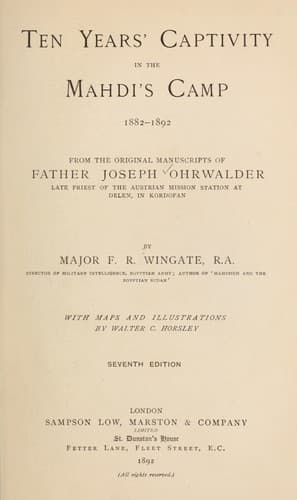
Ten Years' Captivity in the Mahdi's Camp 1882-1892Ohrwalder, Josef
Religion
Ten Years' Captivity in the Mahdi's Camp 1882-1892
Ohrwalder, Josef
Mahdi, Muhammad Ahmad, 1848-1885; Sudan -- History
Several Arabs, who have considerably less knowledge of the world than
the Gellabas, have lost all they possessed by these swindles. The
Omdurman market is, I suppose, the scene of more swindling and deception
than any other place of its size in the world. There is no shame in
being a thief or a swindler; it is only when one is found out that some
shame attaches.
Several masters keep slaves for the express purpose of getting them to
rob and steal, and share the profits with them. Slaves of this
description are valuable commodities, as, if they are discovered, it is
generally pretty certain that their master can bribe the judges; but
this, of course, all depends on the relations which exist between the
individual and the local authorities. Thus tobacco-smokers and
marissa-drinkers must pay a monthly sum to the sheikh es suk, which
enables them to carry out their lawless practices with impunity. If any
such individual refuse to pay, his habits are at once reported, and he
is severely punished, the confiscated tobacco being then sold by the
police.
Complaints against these evil practices, and regarding the absence of
public security in Omdurman, grew so continuous and so serious, that at
length the Khalifa was obliged to interfere, and the following case
brought the matter to a head. A drunken slave had shot one of his fellow
slaves. In accordance with the law, the master is permitted to take the
offending slave's life; but he forgave him, because he did not wish to
lose two slaves at once.
When the Khalifa heard of the case, he at once ordered the slave to be
executed. After this, every one came and told him about the smokers and
marissa-drinkers; and then and there he appointed a certain Wad er Reis,
also named Hussein Wad ed Dayim, as sheikh of the market.
This man, who had been formerly Mamur of the Berber police, succeeded in
making himself feared by the thieves. He openly told the Khalifa that it
would never do to treat thieves according to the law, and that only the
strongest and most energetic measures would effect the breaking up of
the band.
The Khalifa agreed; and at once the new chief of police seized all the
well-known thieves and put them in chains. They were then bastinadoed,
and forced to confess what they had stolen, to whom the goods had been
sold, and their value. And thus they got to know the names of almost all
the thieves in the town.
Public-domain text, read in full here on John Shaqi.
Reviews
Reviews
No reviews yet
Be the first to share your thoughts on this work.
Elsewhere in the archive
Join the Discussion
Join the discussion
Sign in to leave a comment or review.
Sign InorCreate an account