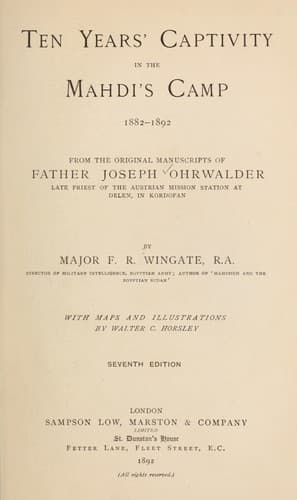
Ten Years' Captivity in the Mahdi's Camp 1882-1892Ohrwalder, Josef
Religion
Ten Years' Captivity in the Mahdi's Camp 1882-1892
Ohrwalder, Josef
Mahdi, Muhammad Ahmad, 1848-1885; Sudan -- History
These measures created a great sensation in Omdurman, for it was found
that several people in high places were implicated, and they were
convicted. The thieves, too, seized this opportunity for extorting
hush-money; but Wad er Reis soon re-established public security. To
increase the supervision, he divided the market into quarters, over
which he appointed sub-sheikhs (known as sheikh el hara), who were
responsible, with the assistance of the inhabitants of the quarter, for
preserving security at night. Numbers of marissa-drinkers were
apprehended, and a large quantity of confiscated tobacco was publicly
burnt in the market-place. All the principal thieves were transported to
the convict-station at Regaf, a course which the Khalifa thought
preferable to mutilation of the hand and foot.
Just about this time an Egyptian convict, who had escaped from Sawakin,
arrived in Omdurman. He had been convicted of false coining in Egypt,
and had been sentenced to ten years penal servitude at Sawakin. While in
the prison there, he and a companion had come to an agreement with the
soldier guarding them, and all three had escaped and set off for Berber.
The soldier and the other man had died on the journey, and the survivor,
having reached Omdurman, begged to be presented to the Khalifa; but
Abdullah thought it beneath his dignity to interview an escaped convict.
He was therefore transferred at once to the steamer bound for Regaf with
all the thieves and other exiles, whilst the Khalifa was heard to remark
that anyone who came from Egypt was invariably a criminal or dishonest
man.
The new posts of sheikh el hara were unpaid, and as the holders had to
live, they were forced to make money by unfair means. This led to the
old tobacco and marissa abuse, so that matters soon drifted back into
much the same condition as before.
The caravan roads into the interior are fairly safe, but merchants
always prefer to travel in parties of twenty to thirty; though, as a
matter of fact, the Baggara garrisons at the various posts are a much
greater source of danger to the merchants than are the thieves and
brigands. These Baggara wring money out of the merchants, and steal
their goods; but if the caravan is large, they are afraid to do anything
which may lead to reprisals. The Khalifa has, however, done much to
improve public security in the provinces, and punishes severely when
cases are brought to his notice.
The state of public morality in the Sudan is very bad, and in Omdurman
it could not well be worse. Before the Mahdi appeared, matters were bad
enough. Almost all the large towns, such as Khartum, Messalamieh,
Metemmeh, and El Obeid--especially the latter--were hotbeds of
immorality of the very worst description.
Public-domain text, read in full here on John Shaqi.
Reviews
Reviews
No reviews yet
Be the first to share your thoughts on this work.
Elsewhere in the archive
Join the Discussion
Join the discussion
Sign in to leave a comment or review.
Sign InorCreate an account