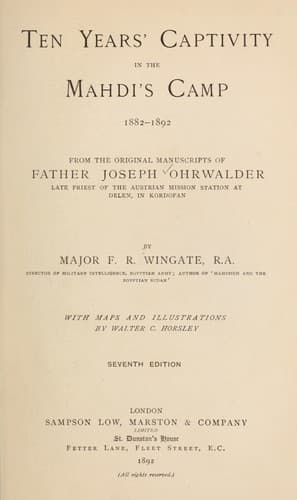
Ten Years' Captivity in the Mahdi's Camp 1882-1892Ohrwalder, Josef
Religion
Ten Years' Captivity in the Mahdi's Camp 1882-1892
Ohrwalder, Josef
Mahdi, Muhammad Ahmad, 1848-1885; Sudan -- History
"Saier!" In the Sudan the bare mention of this word causes a shudder.
The ordinary word for prison is "siggen," but Saier is really a
contraction for beit es Saier (_i.e._ the house of the Saier). Saier is
the name of a terrible individual of the Gowameh tribe of Kordofan, who
has been gaoler since the early days of the Mahdi, and his name has
become the synonym of the horrible place of which he is the guardian.
A curious story is told about his name which is said to be true. The
Gowameh women are not renowned for moral virtue, and when Saier was born
his mother was asked whose son he was; she was unable to say, and when
brought before the authorities and again questioned, she replied that it
was "Saier" (_i.e._ it was the custom of her country); the boy was
therefore called Saier, and the name clung to him.
Up to the time of the fall of Khartum, the prison had been merely a
large zariba, and it was only after the Mahdi's death that a wall, built
by the prisoners themselves, took the place of the thorn hedge. It is
situated on the river bank, and consists of a large yard, in the centre
of which is a building made of mud, straw, and stones, known as "abu
haggar" (or the stone hut), with small square openings for a window and
a door; near the hut is a well. In one corner are the cells, which are
scarcely large enough to contain a man, and which had been built by
Charles Neufeld.
The ordinary prisoners are not kept apart, but lie under the shade of
the wall during the day, and at night they are packed, some into the abu
haggar and some left to lie about in the yard. A few of the well-off
prisoners, who are in for long terms of imprisonment, have been allowed
to build little huts for themselves. And just behind the gate is a small
sun-dried brick building, which belonged to Wad Gazuli, late sub-Mudir
of Khartum, who deserted to the Mahdi before Gordon's arrival; this hut
is only big enough for two people, and so low that it is impossible to
stand upright in it.
It is considered a very great favour to be given a hut of this
description--a favour which is only conferred on very privileged
prisoners; it is, moreover, very expensive, but it has this merit, that
the occupier can at any rate live separately. There are only three huts
of this description in the prison.
Prisoners are not allowed to use mattresses, but the owner of a hut can
have a small platform slightly raised from the ground, on which he is
allowed to sleep. The ordinary prisoners generally lie on their
sheepskins or on mats stretched on the ground.
Public-domain text, read in full here on John Shaqi.
Reviews
Reviews
No reviews yet
Be the first to share your thoughts on this work.
Elsewhere in the archive
Join the Discussion
Join the discussion
Sign in to leave a comment or review.
Sign InorCreate an account