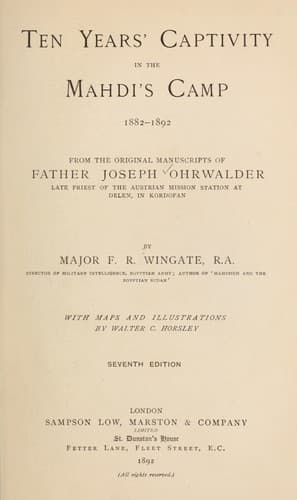
Ten Years' Captivity in the Mahdi's Camp 1882-1892Ohrwalder, Josef
Religion
Ten Years' Captivity in the Mahdi's Camp 1882-1892
Ohrwalder, Josef
Mahdi, Muhammad Ahmad, 1848-1885; Sudan -- History
This, however, was the only execution of the sort which took place
during Mahdiism. The other women were released; but the only effect of
the above example was to induce women to take criminal means to rid
themselves of these evidences of illicit connection; and the open sale
of abortive medicines only tended to further increase the moral
decadence of the people. One can truthfully say that feelings of horror
and shame scarcely exist in the Sudan. From slaves of all ages and
sexes, to the little child of six years old, all are instructed in the
very worst forms of immorality; but on this painful and disgusting
subject I will say no more.
Gradually the simple marriage laws introduced by the Mahdi gave place to
the old former customs. For example, the Emir of Berber, Abdel Majid,
married the daughter of Abderrahman Bey Ben en Naga, and received from
her father 2,000 grammes of gold. The marriage ceremony, which was
celebrated with dancing and singing, lasted about a month; but when the
Khalifa heard of it, he had the emir imprisoned for some months,
declared the marriage dissolved, sent the bride back to her father, and
forbade him to let the bridegroom ever take her again.
But the Sudanese have a passion for such ceremonies involving dancing
and singing, and will never be restrained by any of these new laws. The
women wear jewellery as before; they dance, sing, and prepare marissa;
games of chance too are quite in vogue; but of course everything is
carried on secretly. From time to time the Khalifa raises his voice
against it, and then for a few days everything stops; but it soon breaks
out again, and goes on just as before.
The festivals consequent on the termination of Ramadan, on Bairam, on
the occasion of births, circumcisions, &c., are not carried out with any
degree of their former brilliance. Perhaps a meat meal is given, and
visits paid two or three times in the year. The old days of rejoicing
have vanished, all is anguish and fear, no man's life and property are
secure; every one has perforce to break the laws, which are most of them
quite impracticable, and at the same time are in constant fear of spies,
who are everywhere. There is no security, justice, or liberty; and
happiness and content are unknown.
CHAPTER XX.
THE KHALIFA'S TREATMENT OF THE WHITE CAPTIVES.
Description of the prison, or "Saier"--The "Abu Haggar"--The
imprisonment of Charles Neufeld--Terrible sufferings of the
prisoners--Domenico Polinari--The danger of corresponding with the
European prisoners--Neufeld threatened with death--He is given
charge of the saltpetre pits--The fate of Sheikh Khalil, the
Egyptian envoy--The Khalifa's treatment of the "Whites"--Exile to
the White Nile.
In the preceding pages frequent reference has been made to the prison.
This is an institution of so much importance in connection with Mahdiism
that it merits a description in detail.
Public-domain text, read in full here on John Shaqi.
Reviews
Reviews
No reviews yet
Be the first to share your thoughts on this work.
Elsewhere in the archive
Join the Discussion
Join the discussion
Sign in to leave a comment or review.
Sign InorCreate an account