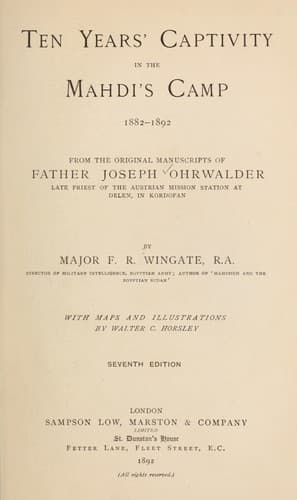
Ten Years' Captivity in the Mahdi's Camp 1882-1892Ohrwalder, Josef
Religion
Ten Years' Captivity in the Mahdi's Camp 1882-1892
Ohrwalder, Josef
Mahdi, Muhammad Ahmad, 1848-1885; Sudan -- History
The war material, just as it had been left by Gordon in the Mission
house, was still there, and it happened that one day some powder was
stolen. In spite of the most careful inquiries, it was impossible to
trace the thief, and now the ex-gardener began to throw out hints that
Polinari was implicated in the theft. A certain Hajji Zubeir was
entrusted with the inquiry. Polinari's hut was overhauled, but nothing
found in it; his honesty was so well known that no one would credit any
evil reports or slander against him. But the ex-gardener was not to be
put off. Having failed in his first accusation, he now began to spread
reports that Polinari drank liquor and chewed tobacco, and in proof of
this he produced a large glass bottle and some dried herbs; there were
some fresh dates in the bottle, with which Polinari intended making
vinegar, which the gardener insisted was liquor; the dried vegetable was
a sort of cabbage which Polinari intended cooking for his food, but this
the Dongolawi asserted to be tobacco.
The unfortunate Polinari was obliged to walk through Omdurman with the
bottle on his head, followed by an insulting and disorderly crowd, until
he came before the judge. Kadi Ahmed, who was well known for his
partiality to Europeans, at once recognised that this was all a
trumped-up slander, and was anxious to release Polinari; but Hajji
Zubeir, who had still great influence with the Khalifa, and instigated
by the ex-gardener, sent him off to the Saier. Every other day we used
to send him some bread and dates, but the slave to whom the food had
been consigned never delivered it, as we afterwards discovered, and had
it not been that two of the sheikhs, who were fellow-prisoners with him,
had given him some of their food, he must have died of starvation.
Amongst the many Sudanese who have at various times been inmates of the
Saier, may be mentioned the aged sheikh of the Shukrieh, who had been
most loyal to Gordon, Awad el Kerim Abu Sin--he died in prison; Wad
Zaid, of the Debaineh tribe, had been kept in prison four years; then
there were Ahmed Wad Suleiman, who had been the Mahdi's chief of the
beit el mal; Saleh Pasha Wad el Mek, one of Gordon's principal officers;
the Ashraf Sayid Abdel Kader and Sayid Abdel Kerim; Wad Adlan we have
already referred to; Jabrallah, Sultan of Darfur, and his five sons,
most of whom died; Wad en Nejumi; Sheikh Idris; Makin Wad en Nur, and
many others.
When the Khalifa's tribe, the Taisha, first arrived, they plundered the
market, and Abdullah threw 200 of them into prison, "to teach them," he
said, "the right way." Every night fifty of them were driven into the
stone hut, which was, indeed, a terrible change from their forests and
plains. Every day several died of typhus fever, and now the mere mention
of Saier makes them tremble; even their head sheikh, El Ghazali, whose
misfortunes I have already narrated, spent some months in prison before
he made his unsuccessful attempt to escape.
Public-domain text, read in full here on John Shaqi.
Reviews
Reviews
No reviews yet
Be the first to share your thoughts on this work.
Elsewhere in the archive
Join the Discussion
Join the discussion
Sign in to leave a comment or review.
Sign InorCreate an account