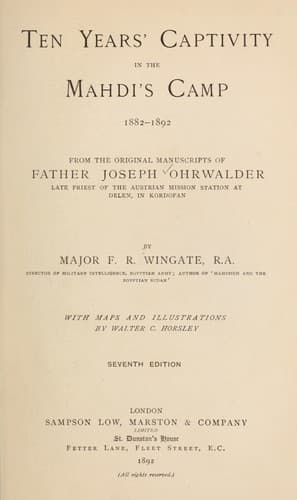
Ten Years' Captivity in the Mahdi's Camp 1882-1892Ohrwalder, Josef
Religion
Ten Years' Captivity in the Mahdi's Camp 1882-1892
Ohrwalder, Josef
Mahdi, Muhammad Ahmad, 1848-1885; Sudan -- History
The Saier thoroughly understands how to work his influence, for he
benefits considerably by his exercise of power; he receives no pay, and
therefore he is entirely dependent on what he can make out of the
prisoners. The richer his victims, the more pleased he is, for he knows
he can wring money out of them freely. Once a month the judge or his
representative goes with a clerk to the Saier and makes a list of all
the prisoners, showing how long each prisoner has been in confinement.
On these occasions numbers of the inmates throw themselves at the feet
of the judges and beg to be released because they are starving. This
list is shown by the judge to the Khalifa, and Charles Neufeld's name
always appears at the top. Abdullah goes through the list, makes careful
inquiries about the prisoners, some are released and others passed over
in silence, a sign which bodes them no good.
The Saier has seen and heard not a few of the misfortunes of both
Sudanese and Europeans. The first Europeans he knew were Slatin Bey and
Lupton Bey. Gustav Klootz was put into chains in Abu Girgeh's camp.
During the siege of Khartum it was thought the Europeans might attempt
to escape to Gordon, they were therefore put in chains; both Slatin and
Lupton spent upwards of ten months in chains under the Saier; they
suffered dreadfully from hunger and ill-treatment, and were frequently
threatened with death. After the fall of Khartum they were released, and
were told by the Khalifa that they should feel thankful to have been in
prison, otherwise they would undoubtedly have shared Gordon's fate.
One of our Mission brothers, Domenico Polinari, was also kept in prison
for six months; he was imprisoned the same day that I arrived from
Kordofan.
After the fall of Khartum, Polinari's brother had been working as
gardener in the Mission grounds, under his new master, the Khalifa
Sherif. The former gardener, a Dongolawi, had been dismissed for
dishonesty, and before he left, Sherif ordered him to be carefully
examined, as it was thought he might have taken some of his master's
property. Polinari, who was a most conscientious man, and had never even
taken a lemon without his master's permission, carried out the search
most carefully, and succeeded in getting back quantities of things the
thief had made away with. For a time the thief said nothing, but soon
his innate Danagla astuteness came to his assistance, and he concocted a
plan to revenge himself on Polinari, and again become chief gardener.
Public-domain text, read in full here on John Shaqi.
Reviews
Reviews
No reviews yet
Be the first to share your thoughts on this work.
Elsewhere in the archive
Join the Discussion
Join the discussion
Sign in to leave a comment or review.
Sign InorCreate an account