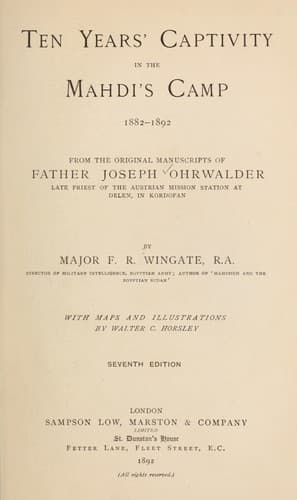
Ten Years' Captivity in the Mahdi's Camp 1882-1892Ohrwalder, Josef
Religion
Ten Years' Captivity in the Mahdi's Camp 1882-1892
Ohrwalder, Josef
Mahdi, Muhammad Ahmad, 1848-1885; Sudan -- History
It was generally believed that Khalil had blamed the Khalifa for his
ill-treatment and oppression of the Moslems, and had shown him how his
rule was ruining the Sudan. He had begged him to abandon the evil of
Mahdiism and return to the true orthodox religion. Whilst in confinement
at Kererri he was frequently threatened with death. No one knew what his
mission could be, and the Khalifa knew how to guard it secretly, so that
gradually people began to forget all about him, and great was the
surprise when one day Khalil and his companion appeared riding on mules
at the great parade held during the Bairam festival.
The Khalifa brought Khalil here to show him how immense was his power
and authority, and just before the parade was concluded Abdullah and all
the cavalry galloped up to him, surrounded him, and asked whether he
would not rather stay in the shadow of the Mahdi's dome than return to
Egypt. Khalil, who had now been for upwards of five months in
confinement, and thinking that he should never be allowed to leave, and
at the same time longing to be allowed to return and report to the
Government all he had seen, replied diplomatically that having once been
in the light he had no wish to return to darkness.
This reply delighted the Khalifa, who ordered him to be set free, and at
prayers in the mosque on that day he sat in the centre of the long line
of Ansar just behind the Khalifa.
It is the custom at festivals for all European prisoners, Greeks,
Syrians, Jews, &c., to go and offer the Khalifa their good wishes. When
they arrived on this occasion the Khalifa ordered them to be seated
around him--he does not allow them to kiss his hand, as he might thereby
become contaminated with their impurity; he usually makes a speech,
pointing out the punishments which may fall upon them; but this time he
was particularly gracious, asked how they were all getting on, and if
they had met with ill-treatment or injustice at the hands of anyone. He
gave them to understand that they must look on him as their protector,
and that should they die their children would become their heirs, and
that if a family had no children, the property would be sold and divided
amongst the other prisoners.
This kindly speech was a great surprise to us all; but the astute
Khalifa only wanted to show Khalil how well he treated his prisoners. It
is possible, also, that Khalil had observed to him how badly we really
were treated, but this is only surmise on my part. Abdullah's kindly
speech, however, did us much good, for of course all he says goes the
round of the whole town, and when the people knew that we had been well
received, they showed us much greater kindness and respect. If, on the
other hand, the Khalifa ever imputes a word of blame to any of us, the
reaction on the people is immediate, and we are at once insulted and
maltreated. It is always said that "the whites"--which is the name by
which we are known in the Sudan--"live under the shadow of the sword."
Public-domain text, read in full here on John Shaqi.
Reviews
Reviews
No reviews yet
Be the first to share your thoughts on this work.
Elsewhere in the archive
Join the Discussion
Join the discussion
Sign in to leave a comment or review.
Sign InorCreate an account