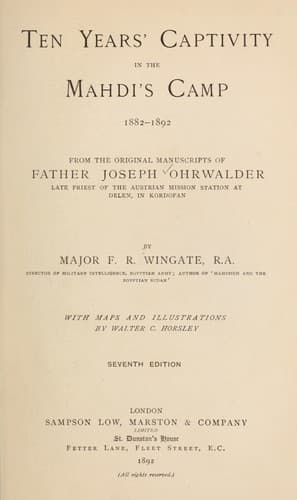
Ten Years' Captivity in the Mahdi's Camp 1882-1892Ohrwalder, Josef
Religion
Ten Years' Captivity in the Mahdi's Camp 1882-1892
Ohrwalder, Josef
Mahdi, Muhammad Ahmad, 1848-1885; Sudan -- History
The Khalifa then asked Khalil's companion if he wished to return or stay
where he was. The man replied that he was a messenger, pure and simple,
and that as such "he should return to him who sent him," and on the same
day the Khalifa gave him permission to depart.
But now evil reports were spread abroad regarding Khalil. It was said
that he was a great friend of Mustafa Yawer, the ex-Mudir of Dongola,
and that it was mainly through his influence that he prevented him
adopting Mahdiism; it was also said that he was the chief of the spies
sent by the English, and a bitter enemy to the Mahdi. It was imprudent
under such circumstances of Khalil to go as an envoy to Omdurman. He had
given his services to the Government for this purpose, and he bravely
adhered to it; but he was well known to the inhabitants of Dongola and
Dar Shaggieh, and it was quite certain that the Khalifa would never
permit such a man to return to Egypt. Even in Omdurman he would not
allow him to be at large.
Two days later the judges were assembled to consider Khalil's case:
false witnesses came forward who asserted that they had seen Khalil
worshipping the sun and frequently turning towards the west at prayers,
and all sorts of stories were trumped up to induce the Khalifa to put
Khalil in chains.
The pliable judges condemned the sheikh, and he was relegated to the
Saier. Neufeld had to give up his cell, which was made over to Khalil.
None of the prisoners were allowed to speak to him--thus was the poor
man left without a friend or acquaintance to help him; everyone shunned
him as if he were the victim of some foul disease. From the earliest
days of Mahdiism it was always the fate of those who fell in favour to
be deserted by all, and this was more especially the case with all those
on whom the Khalifa's wrath fell. Thus everyone--fearing for his own
life--avoids all intercourse with such prisoners.
When Khalil had expended the little money he possessed, he sold his
sword, sheepskin, and clothes, and bought bread--such bread too!--even
Sudanese, who are accustomed to eat all sorts of stuff, could only eat
prison bread when hunger had made them like ravenous wolves; but Khalil
had come from Egypt and its flesh-pots, and the Sudan bread made him
ill.
At length he had no more money to buy even bread, and then he suffered
the pangs of hunger. For a month before his death his beard had grown
quite white, and he himself had become like a skeleton. His wretchedness
and loneliness brought on sickness, and he died a miserable death. It
occurred on a Friday whilst the Khalifa was attending a review, and
Abdullah accidentally fell from his horse on that day, but was caught
before he reached the ground. This was considered a very bad omen by the
people, who thought that Khalil had been unjustly condemned. They
believed it pointed to the overthrow of the Khalifa's rule, and he
himself was very much disturbed.
Public-domain text, read in full here on John Shaqi.
Reviews
Reviews
No reviews yet
Be the first to share your thoughts on this work.
Elsewhere in the archive
Join the Discussion
Join the discussion
Sign in to leave a comment or review.
Sign InorCreate an account