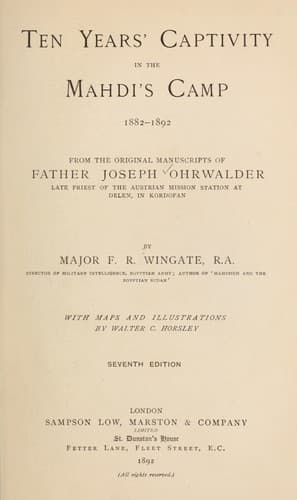
Ten Years' Captivity in the Mahdi's Camp 1882-1892Ohrwalder, Josef
Religion
Ten Years' Captivity in the Mahdi's Camp 1882-1892
Ohrwalder, Josef
Mahdi, Muhammad Ahmad, 1848-1885; Sudan -- History
Generally about a month before the rains begin, and when the Khalifa
permits it, the people leave the town in crowds and repair to the
fields, which they set to work to clear. After the famine year of 1889
the Khalifa did everything in his power to induce the people to turn
their attention to agriculture. Plentiful rain and hard work produced
excellent crops in 1890. Dhurra, dukhn, cotton, sesame, onions, and
various sorts of beans are grown.
The operation of sowing requires little time or trouble; the fields are
cleared of all the stumps, roots, &c., of the preceding harvest, which
are burnt, then every one raises a small bank of earth around his
ground, so as to retain the water and enable the earth to become
thoroughly saturated. This measure is specially necessary in the
Gezireh, where the clay soil does not absorb quickly, whilst in the
sandy plains of Kordofan it is exactly the reverse.
As soon as the parched ground has absorbed the first rains, sowing is
begun without delay; the soil is turned over with iron or wooden hoes,
and the seed thrown down. Weeds spring up in great profusion, and it
requires endless trouble to prevent their choking the young growth.
Dhurra ripens in about two months, dukhn in three. The fine quality,
such as Shilluk dhurra, takes six months to come to maturity. The
gathered corn is threshed, and then stored in holes in the ground, where
it can be kept without deteriorating for upwards of ten years.
Along the Nile, sowing and reaping goes on the whole year through. Water
is drawn up by the sakiehs, or water-wheels, and distributed over the
fields. After the wars, numbers of these water-wheels which had been
destroyed, were reconstructed. Now there are a great number in working
order, and the banks are covered with green. All work is done with the
iron or wooden hoe, and the plough is not used at all. The only plough I
ever saw in the Sudan was one worked by an Egyptian in Khartum, and it
caused no small astonishment amongst the natives. Wheat and maize--or,
as it is called in the Sudan, "Aish er rif" (Egyptian bread)--ripens in
forty days.
In Kordofan quantities of broad beans are grown, as well as sesame,
sugar-cane, cotton, onions, garlic, bamiahs, radishes, tomatoes,
cucumbers, and water-melons; while Indian figs, pomegranates, lemons,
oranges, citrons, bananas, and grapes are grown in profusion in the
Khartum gardens. Date-palms are plentiful on the Blue Nile and further
south; but it is not possible to dry them, for they at once become full
of insects. Rain often spoils the date harvest.
Besides agriculture and cattle-breeding, the Sudanese may be called a
thoroughly pastoral nation. During the long wars against the Government,
as well as in the internal disturbances, the camels and oxen were almost
exterminated; and in 1889 a cattle plague still further reduced the
numbers.
Public-domain text, read in full here on John Shaqi.
Reviews
Reviews
No reviews yet
Be the first to share your thoughts on this work.
Elsewhere in the archive
Join the Discussion
Join the discussion
Sign in to leave a comment or review.
Sign InorCreate an account