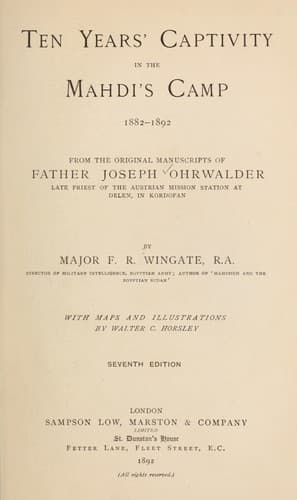
Ten Years' Captivity in the Mahdi's Camp 1882-1892Ohrwalder, Josef
Religion
Ten Years' Captivity in the Mahdi's Camp 1882-1892
Ohrwalder, Josef
Mahdi, Muhammad Ahmad, 1848-1885; Sudan -- History
When Fashoda was occupied, quantities of cows were taken from the
Shilluks and sent either to Gezireh or on to the Berber market, in order
to try and stimulate breeding. There are quantities of goats and sheep,
as only a comparatively small number of these have been killed; but the
greatest loss has been in camels, and it is not so easy to replenish the
country in this respect. There are still a considerable number of
donkeys, which are used both for riding and as pack-animals. A good
donkey will fetch from forty to two hundred dollars.
The Sudanese are born traders and dealers; it is almost a passion with
them, and they like the travelling which trade involves. Of course the
flourishing commerce of the old days has been quite destroyed. The
import of goods to the Sudan from the north and east was formerly in the
hands of one merchant. The Berber-Sawakin and Berber-Korosko roads were
opened through Wad Adlan, and the re-occupation of Tokar by Egypt has
done a great deal to help commerce. Wad Adlan's successor, Nur
Gereifawi, established the ushr (or one-tenth tax) on all important
goods, in addition to the "zeka," or two and a-half per cent., which was
formerly the only tax levied.
This increase in taxation has rather impaired than improved trade, but
it is still fairly brisk. However, the "ushr" was levied twice, in both
Omdurman and Berber, so that the beit el mal obtained twenty-two and
a-half per cent. profit on all imported goods. This exorbitant taxation
led to goods being smuggled into the town by night. In spite of every
precaution being taken, smuggling still continued; and at last it was
decided that all merchants should have their goods stamped at the beit
el mal.
This stamp bears the words, "Ushr beit el mal el umum" ("The
tenth--general beit el mal"), and no goods are allowed to be sold unless
they are thus marked. The head of the beit el mal himself also went to
the market and personally stamped all the private goods of merchants;
and in this way the fraud was stopped. A merchant selling unstamped
goods would have all his property confiscated.
All went well for a time; but soon it was discovered that false stamps
were in use. This led to another inspection of all goods in the market,
and the confiscation of a considerable quantity of property, an
operation which caused business to be suspended for about eight days.
Public-domain text, read in full here on John Shaqi.
Reviews
Reviews
No reviews yet
Be the first to share your thoughts on this work.
Elsewhere in the archive
Join the Discussion
Join the discussion
Sign in to leave a comment or review.
Sign InorCreate an account