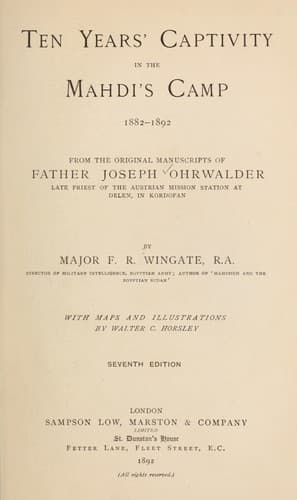
Ten Years' Captivity in the Mahdi's Camp 1882-1892Ohrwalder, Josef
Religion
Ten Years' Captivity in the Mahdi's Camp 1882-1892
Ohrwalder, Josef
Mahdi, Muhammad Ahmad, 1848-1885; Sudan -- History
Export of slaves to Egypt and the Red Sea is forbidden, because the
Khalifa fears that the English may intercept them and make soldiers of
them; but a certain number of female slaves are still smuggled through.
By the re-occupation of Tokar the Red Sea route, which had been
extensively used, was closed to the Dervishes. It is permissible to give
male and female slaves papers of freedom, but the custom is never
practised. If a female slave bear a child to her master she cannot be
sold, and after her master's death she becomes a free woman; if she bear
a child to a freed man, who is not a black, her position remains
unaltered, and the child grows up a slave, because it is considered to
be illegitimate.
Omdurman is full of slaves; even in the poorest houses one female slave
at least will be found. Hard work and ill-treatment ages them very
rapidly. Many of them long for their native homes and detest slavery,
but the great majority of them submit without a murmur to their wretched
fate.
FOOTNOTES:
[R] The disease lies dormant in the summer, but acquires
virulence with cold weather. The medicines used are iodide of potassium
and sarsaparilla.
CHAPTER XXIII.
THE BAGGARA MASTERS OF THE SUDAN.
Relations between Abdullah and the rival Khalifas--Mahdiism
practically dead--The Khalifa's son, Osman--His marriage to Yakub's
daughter--His intentions regarding the succession--The Baggara and
the Aulad-Belad--The Baggara masters of the Sudan--Examples of
their tyranny--Emigration of the Rizighat tribe--Hostility between
the Khalifa's and the late Mahdi's households--The Ashraf
conspiracy--Witchcraft--The dispute between the Khalifas--Riots in
Omdurman--The Mahdi's widows.
I propose to devote this chapter to a brief outline of the relations
which exist between the ruling powers in Omdurman, and a description of
the present situation in the Sudan. The overthrow of Nejumi at Toski,
the destruction of Abu Anga's immense army during his constant campaigns
in Abyssinia, the year of famine in 1889, and finally the capture of
Tokar and total defeat of Osman Digna in February 1891, have all tended
largely towards the diminution of Khalifa Abdullah's power.
Whilst the operations against Abyssinia and Egypt were being carried on,
the provinces in the interior of the Sudan were slowly recovering from
the terrible strain through which they had passed. Dongola, Kassala, and
Darfur suffered most. The depredations of Nejumi's wild Dervishes had
entirely desolated the once fertile province of Dongola, and is it any
wonder that its wretched inhabitants should cast longing eyes towards
wealthy and prosperous Egypt?
Public-domain text, read in full here on John Shaqi.
Reviews
Reviews
No reviews yet
Be the first to share your thoughts on this work.
Elsewhere in the archive
Join the Discussion
Join the discussion
Sign in to leave a comment or review.
Sign InorCreate an account