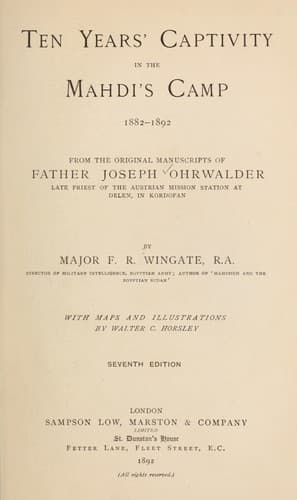
Ten Years' Captivity in the Mahdi's Camp 1882-1892Ohrwalder, Josef
Religion
Ten Years' Captivity in the Mahdi's Camp 1882-1892
Ohrwalder, Josef
Mahdi, Muhammad Ahmad, 1848-1885; Sudan -- History
The lot of a slave is indeed a miserable one. He is looked upon as an
animal created, as the Sudanese say, to make the life of Moslems easy;
he must do all the hard work, both in the household and in the field. It
is the idea of the Sudanese, that if a slave gets sufficient food he
always becomes proud and unmanageable. His dress consists merely of a
rag tied round his loins: whatever money he may make by his work is the
property of his master.
The female slaves carry water and grind corn, in return they are
continually blamed and cursed; any disobedience or dishonesty is
punished by flogging, or their bodies are gashed with razors, salt being
rubbed into the wounds, and, lest they should have any cause to forget,
their half-healed cuts are often ripped open again and salt rubbed in
afresh.
In the treatment of their slaves women are more cruel than men, more
especially if jealousy is the cause of their anger. Woe to the
unfortunate female slave who shows any love for her master! She suffers
a species of torture which it would be impossible for me to describe
here, and what wonder is it that in despair they often fly from their
masters and mistresses?
Yet it is only by this harsh treatment that slaves can be made obedient;
it is a very true saying that a person who is forcibly deprived of
liberty can only be brought into subjection by force. Slaves under
Mahdiist _régime_ have so many different ways of revenging themselves on
their masters that they never fail to seize an opportunity when it is
offered.
The immorality of slaves is quite beyond description; but it cannot be
the fault of the unfortunate creatures themselves, for in their own
savage homes it is not so. They learn all the vices of their masters,
and, indeed, are forced to participate in them or submit to a flogging;
consequently, disease of the most loathsome kind is everywhere
prevalent, and to be free from it is thought to be the mark of a poor
creature. In many cases which have come within my own knowledge, the
offspring of such people die young, putrid by disease; of fifteen
children of one father, thirteen died in five years. At first the
Baggara were not infected to any large extent, but contact with the
inhabitants of the Nile valley has communicated the pest, which is now
eating into the constitutions of this, the most powerful and warlike
tribe in the Sudan.[R]
Public-domain text, read in full here on John Shaqi.
Reviews
Reviews
No reviews yet
Be the first to share your thoughts on this work.
Elsewhere in the archive
Join the Discussion
Join the discussion
Sign in to leave a comment or review.
Sign InorCreate an account