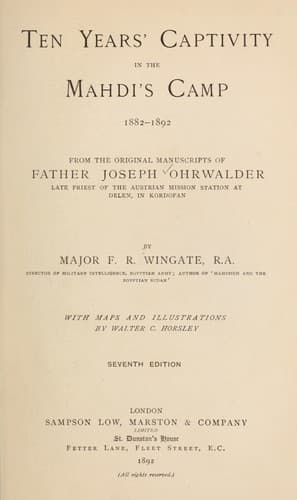
Ten Years' Captivity in the Mahdi's Camp 1882-1892Ohrwalder, Josef
Religion
Ten Years' Captivity in the Mahdi's Camp 1882-1892
Ohrwalder, Josef
Mahdi, Muhammad Ahmad, 1848-1885; Sudan -- History
From the way in which his eldest son Osman is being brought up, it is
evident that Abdullah seeks to establish an hereditary succession. This
youth was, until recently, of a most overbearing disposition. Whenever
he saw anything he wanted, he insisted on its being given to him. If he
saw someone riding a good donkey, he would order the rider to dismount,
and would deliberately cut the poor animal's throat; but in spite of
these foolish and cruel acts, his favour was much sought after, and many
a present did he receive from people who looked for a favourable means
of bringing their demands before the Khalifa; but the latter eventually
became exasperated by his son's conduct. He rebuked him openly in the
mosque, forbade everyone, under pain of severe punishment, to give him a
present of any sort, and he made him over to a tutor with a few Taisha
mulazimin.
This strict _régime_ has already done the boy good. He is now about
eighteen years of age. It was said that the Khalifa's brother Yakub was
very jealous of his nephew, for he had looked on himself as Abdullah's
successor; but, to flatter Yakub and curb his jealousy, the Khalifa
expressed a wish that Osman should be betrothed to his daughter. This
proposition was most acceptable to Yakub; and further, the Khalifa
arranged that his daughter should be married to the Mahdi's son.
Great were the preparations for these princely weddings, which were
carried out with a splendour entirely at variance with the late Mahdi's
laws. The betrothal ceremony was accompanied by dancing and merry-making
in both the Mahdi's and the Khalifa's households, and the air reeked
with perfumes. All the principal merchants and emirs gave rich presents
in the shape of brides' dresses and varieties of costly perfumes; nor
were gold and silver ornaments and velvet missing. The goldsmiths have
invented a new form of jewellery, which has been named "the Khalifa's
stirrups." These ornaments, although absolutely opposed to Mahdi laws,
are extensively worn in both households. Hundredweights of sugar were
brought to Yakub's house, besides dhurra, wheat, butter, oxen, and
fat-tailed sheep, which latter are valued at from twenty to thirty
dollars a head.
It is usual for the bridegroom, or the bridegroom's father, to offer
presents of provisions to the bride, as well as clothes and ornaments,
which are all handed over to her with great ceremony on an appointed
day. Then there is the festival of "tefail," to which women only are
admitted, after which comes "henna day," when the hands and feet of the
bride are dyed red with henna. All these ceremonies are accompanied by
banquets, dancing, and singing. Every evening Yakub entertained hundreds
of the Ansar with rich food, and distributed several ardebs of dates.
On the occasion of the "dakhul" the bride is taken to the bridegroom's
house late in the evening; for seven days afterwards they receive the
congratulations of their friends, and then the ceremony and festival are
ended.
Public-domain text, read in full here on John Shaqi.
Reviews
Reviews
No reviews yet
Be the first to share your thoughts on this work.
Elsewhere in the archive
Join the Discussion
Join the discussion
Sign in to leave a comment or review.
Sign InorCreate an account