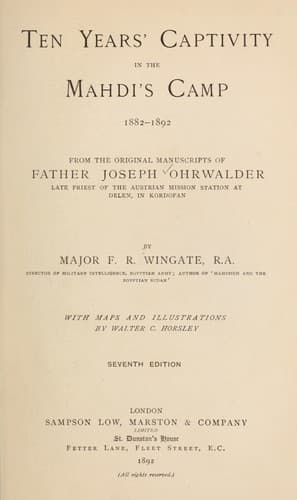
Ten Years' Captivity in the Mahdi's Camp 1882-1892Ohrwalder, Josef
Religion
Ten Years' Captivity in the Mahdi's Camp 1882-1892
Ohrwalder, Josef
Mahdi, Muhammad Ahmad, 1848-1885; Sudan -- History
From the pomp and ceremony with which the Khalifa surrounded his son's
wedding, it is evident to all who thought about the matter that he had
secret intentions. After the wedding he had a princely house built for
his son, in the place known as Abu Anga's yard, near the mosque; this he
quite disfigured by building houses all around it, which are considered
the best in the town. When the palace was completed, the "heir
apparent," who had hitherto been living with his father, moved into it
with great ceremony. The Khalifa gave alms in a most liberal manner, so
that his son's residence might be blessed.
Sayid Osman already takes part in the conduct of affairs, and opens and
reads the letters to the clerks. Almost every morning he rides round
with the Governor on his inspections, but he does not live much amongst
the people. The Khalifa has changed his name into Sheikh Ed Din Sayid
Osman, and now he is generally known as Sheikh Ed Din only; he quite
understands the _rôle_ he has to play. He is a lover of good food, and
rejoices in the little specialities which the merchants bring from
Sawakin and Egypt, such as kamar ed din, dried figs, raisins, and all
sorts of cakes and biscuits, which are brought in abundance to Yakub's
house. The Khalifa treats him with marked respect, occasionally hands
over the command of the parade to him, and the soldiers always present
arms to him.
From the above it is quite evident that Abdullah wishes to secure the
succession to his son. This is perfectly understood by the people, who
make no secret of it. The Khalifa's plan is to go slowly but surely. He
wants to secure the ascendency of the Baggara over the Jaalin, Danagla,
Barabra, and other smaller tribes of the Sudan.
Until the appearance of the Mahdi, the Baggara were, perhaps, the most
despised of all the Arab tribes. The "Aulad-belad," as the Jaalin,
Danagla, and Barabra are called, had become more civilized in virtue of
their geographical position, and are far more crafty by nature than the
Baggara; they despised the latter, and under the leadership of Zubeir
Pasha, they defeated the great tribes in the neighbourhood of Shakka,
and it is these same Baggara who are now their masters.
Public-domain text, read in full here on John Shaqi.
Reviews
Reviews
No reviews yet
Be the first to share your thoughts on this work.
Elsewhere in the archive
Join the Discussion
Join the discussion
Sign in to leave a comment or review.
Sign InorCreate an account