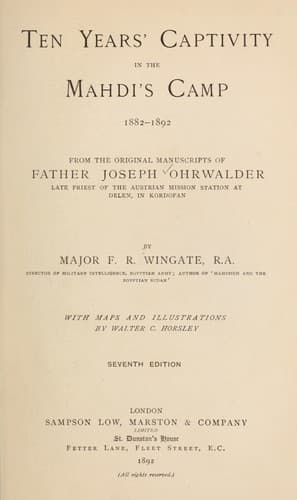
Ten Years' Captivity in the Mahdi's Camp 1882-1892Ohrwalder, Josef
Religion
Ten Years' Captivity in the Mahdi's Camp 1882-1892
Ohrwalder, Josef
Mahdi, Muhammad Ahmad, 1848-1885; Sudan -- History
The Khalifa's policy is to weaken the power of the Aulad-belad and to
strengthen the Baggaras. Just as a good father watches his children, so
does Abdullah watch for every opportunity to further these ends by a
clever combination of leniency and severity. He frequently blames his
own countrymen for their want of gratitude to their benefactor, who has
heaped favours upon them at the expense of the Aulad-belad. On one
occasion he cursed the day on which he had brought them to Omdurman,
calling it a "black day;" but, in point of fact, he is not really
serious when he upbraids them, he rather does it to satisfy the
complainers, and he takes every opportunity of sending the Aulad-belad
as far away from headquarters as possible, so as to strengthen his
central authority by the presence of Baggaras only.
I have already narrated how in the famine year he made the Baggaras pay
only six dollars for an ardeb of dhurra, whilst everyone else had to pay
sixty dollars for the same quantity; thus the Baggara suffered no
hardships and want during that terrible time. They do not like dhurra as
well as dukhn, which is more nourishing, and which they grind in wooden
mortars. During that period of awful want, when hundreds of natives were
dying of starvation in the streets, these great strong Baggaras were
eating to their hearts' content, completely regardless of all the
suffering creatures around them.
The revenue of the beit el mal is expended almost entirely on the
Baggaras; all the fertile islands in the neighbourhood, and the
best-cultivated portions of the Nile banks as far as Berber, have been
made over to them, whilst the original owners of the soil have been
turned out without a piastre's compensation; they are, therefore, owners
of all the best lands, and serve as a foreign garrison in occupation of
a conquered country.
Woe to the native who happens to have a Baggara as his neighbour! His
cattle are robbed, and he must share the product of the fields with his
overbearing master; wherever they go the Baggaras take their horses with
them, which must be fed and cared for at the expense of the local
inhabitants; complaints against Baggaras are not taken the slightest
notice of, or--as it more often happens--the complainant receives a
heavy punishment for having ventured to make a statement which is
invariably construed as untrue and incorrect. Thus these bold tribesmen
have every inducement to become more and more truculent the further
removed they are from the Khalifa's supervision. I will cite an example.
Public-domain text, read in full here on John Shaqi.
Reviews
Reviews
No reviews yet
Be the first to share your thoughts on this work.
Elsewhere in the archive
Join the Discussion
Join the discussion
Sign in to leave a comment or review.
Sign InorCreate an account