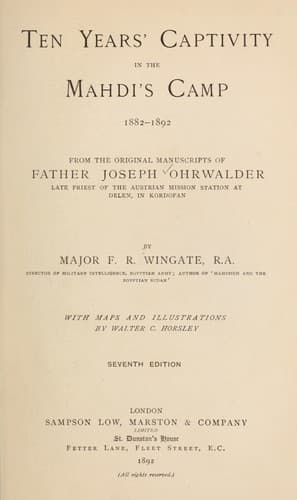
Ten Years' Captivity in the Mahdi's Camp 1882-1892Ohrwalder, Josef
Religion
Ten Years' Captivity in the Mahdi's Camp 1882-1892
Ohrwalder, Josef
Mahdi, Muhammad Ahmad, 1848-1885; Sudan -- History
A rich native of the Gezireh had a dispute with a Baggara, and struck
his oppressor a blow with a stick in self-defence. Fate decreed that the
Baggara should die twenty-eight days afterwards, but his death was not
caused by the blow; the other Baggaras, however, seized the opportunity
of demanding blood-money, and if refused they threatened to report the
matter to the Khalifa. The stupid native was actually intimidated into
giving the Baggara 10,000 dollars, and the matter was declared to be
ended; but somehow it came to Yakub's ears, and learning that the
supposed murderer was a very rich man, he advised the friends of the
deceased Baggara not to accept blood-money, but to insist on the
native's death. This was agreed to. The poor man was arrested, dragged
to Omdurman, and hanged; whilst his property, consisting of a number of
goats and 30,000 dollars, was confiscated.
Not content with this, the Khalifa also ordered that the seven villages
in the neighbourhood should be burnt, on the plea that the inhabitants
had made common cause with the murderer in resisting lawfully
constituted authority; and it was only when the inhabitants of these
villages went _en masse_ to the Khalifa, begging to be spared, that he
at length acceded to their request.
When it was found that the revenue of the beit el mal was insufficient
to provide for the rapidly-increasing Baggara population, Abdullah
ordered half the produce of the Gezireh lands to be given to the beit el
mal, the other half being retained by the owners. This was published as
a solemn decree, and all judges enjoined to see that it was properly
carried out. Ibrahim Nur, the son of Nur Gereifawi, was sent with a body
of soldiers and Baggara to assist in carrying out the order in the
Gezireh, and he gained an unenviable notoriety for the ruthless severity
with which he enforced his authority.
In accordance with the Khalifa's instructions, out of every hundred
ardebs he seized a half, and on the remaining half he levied the "ushr"
and "zeka" taxes, so that eventually the unfortunate cultivator retained
only thirty-seven and a half per cent. of his original quantity;
besides, he was made responsible for the transport to the river of the
sixty-two and a-half per cent. Frequently the fields were far distant
from the river, which involved hiring camels to carry the grain, so that
finally the owner was probably left with absolutely nothing. In this way
Ibrahim gathered upwards of 60,000 ardebs from the Blue and White Niles.
Ibrahim gained the title of the "Gordon of the Gezireh" from the
extraordinarily rapid way in which he moved from one village to the
other and gave his instructions.
Public-domain text, read in full here on John Shaqi.
Reviews
Reviews
No reviews yet
Be the first to share your thoughts on this work.
Elsewhere in the archive
Join the Discussion
Join the discussion
Sign in to leave a comment or review.
Sign InorCreate an account