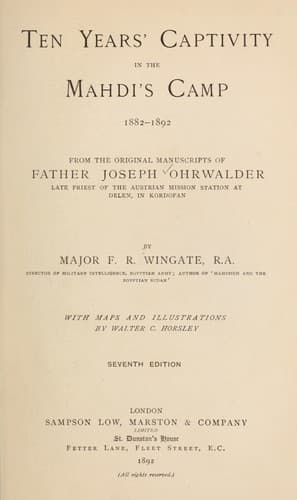
Ten Years' Captivity in the Mahdi's Camp 1882-1892Ohrwalder, Josef
Religion
Ten Years' Captivity in the Mahdi's Camp 1882-1892
Ohrwalder, Josef
Mahdi, Muhammad Ahmad, 1848-1885; Sudan -- History
Not content with having brought the Taisha, Homr, and Habbanieh Arabs
from the west to the Nile, he has still further weakened the Aulad-belad
by obliging the powerful Rizighat tribe to emigrate from their country,
south of Darfur, to Omdurman. Their young Sheikh Musa--son of Madibbo,
who had been killed by Abu Anga at El Obeid--was entrusted with this
mission, and he marched through Kordofan with some 30,000 souls, besides
quantities of horses and cattle; his vanguard had reached Shatt on the
White Nile just at the time that I effected my escape.
The Khalifa had appointed a committee under the notorious Hajji Zubeir
to organize a great reception for the new arrivals, and had made a long
speech in the mosque calling on everyone to come forward liberally with
gifts for their brethren. He urged that alms should not be stinted, but
that clothes, corn, and all sorts of provisions would be gratefully
accepted, even to the "fartaga" (or smallest copper which is coined).
Every emir was instructed to let his followers know of the Khalifa's
wishes; he was to collect the gifts and hand them over to the committee.
If the gifts were considered too small they were returned with a strong
hint that it would be advisable to increase them. Merchants were
especially called upon to give largely, and if they failed to comply
they invariably incurred his displeasure.
The list of gifts was scrutinised by the Khalifa daily, and his favours
apportioned in accordance with what he found there. He was careful not
to allow the rich to give sparingly; for instance, Kadi Ahmed presented
200 ardebs of dhurra, 100 complete suits of clothes, consisting of 100
takias, 100 turbans, 100 jibbehs, 100 pairs of drawers, 100 leather
girths, and 100 pairs of sandals; still Abdullah was not satisfied and
asked why he had not given any money, and immediately the Kadi,
terrified at the Khalifa's displeasure, laid a considerable sum at Hajji
Zubeir's feet.
The merchant Omar Kesha, who had acquired much wealth, had on one
occasion been deprived of 30,000 dollars by the Khalifa on the plea that
much money was apt to take his mind off heavenly considerations. Two
years later a similar sum was again taken from him. On the occasion of
the arrival of the Rizighat, however, he presented a camel-load of
sugar, a camel-load of white muslin, and another of indigo-dyed calico,
besides a quantity of kamar ed din, 50 ardebs of dhurra, a camel-load of
dammur, and a completely-equipped war-horse with its attendant.
Wealthy men offer lavish gifts, in the hope of immunity from plunder,
and Omar Kesha, in addition to his generosity on this occasion, does not
fail to frequently offer valuable gifts to Yakub. As for the Khalifa, he
is perfectly aware that with one word he can, with absolute right,
demand anything and everything he requires, for had not the Sudanese
solemnly pledged their property, their children, and their own lives to
the cause of the Mahdi and his successor?
Public-domain text, read in full here on John Shaqi.
Reviews
Reviews
No reviews yet
Be the first to share your thoughts on this work.
Elsewhere in the archive
Join the Discussion
Join the discussion
Sign in to leave a comment or review.
Sign InorCreate an account