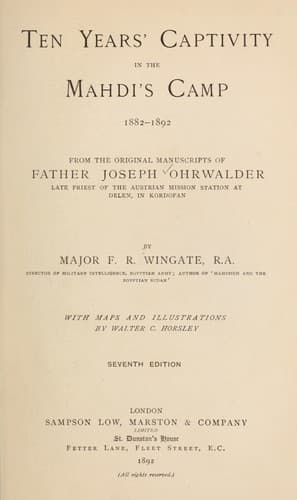
Ten Years' Captivity in the Mahdi's Camp 1882-1892Ohrwalder, Josef
Religion
Ten Years' Captivity in the Mahdi's Camp 1882-1892
Ohrwalder, Josef
Mahdi, Muhammad Ahmad, 1848-1885; Sudan -- History
Here is another proof of the Khalifa's injustice when dealing in matters
concerning his own countrymen. About two days' journey from Omdurman up
the White Nile are certain very highly-cultivated districts, and it
occurred to the Khalifa to send there the Taisha who were not then
employed, so that they might cultivate and at the same time remain in
touch with him. He therefore sent a certain Sheikh Wad el Bedri to
select the most favoured spots in which the Taisha were to settle.
When the inhabitants of these districts learnt what was intended, they
begged and prayed Wad el Bedri to avert this terrible calamity which
threatened them, assuring him that if he would assist them they would do
anything he wanted, short of having the Baggara as settlers in their
country; this request they accompanied with a good round sum of money.
Bedri then returned to Omdurman, waited on the Khalifa with a most
beaming countenance, and reported that the inhabitants of the White Nile
were very pleased that the Khalifa of the Mahdi[S] had been graciously
pleased to think of sending the Taisha to their country; but at the same
time they most humbly begged to submit to him that possibly the Taisha
might find it a trouble to move so far with their families and
followers. If, therefore, the Khalifat el Mahdi should, in his great
wisdom, deem it advisable, they were quite ready to send to their
masters everything they required, and so spare them the toil of making
this extended emigration.
Abdullah seemed delighted with this proposal, praised Sheikh Wad el
Bedri for his services, and agreed that his suggestion should be carried
out. The sheikh appealed to his countrymen, and in one year collected
over 20,000 ardebs of dhurra, besides a quantity of money, which was
distributed amongst the Taisha, who from that day looked on him as one
of their best friends.
There is among the Baggara a curious ejaculation of "Hai! hai!"
constantly interspersed throughout their conversation. The Sudani feels
far more terror at this sound than he ever felt at the sight of the
Egyptian officials' red tarbush.
All high posts are in the Baggaras' hands, or rather in the hands of the
Khalifa's nearest relatives. The emirs of Kordofan, Regaf, Fashoda,
Galabat, Kassala, and Berber, are all Abdullah's relatives. Dongola was
the only place of importance not confided to a Baggara, but now Zogal
has fallen in favour and has been replaced by the Baggari Yunis. Some of
the subordinate posts are, however, still in the hands of the
Aulad-belad, but, gradually, as the Baggaras become capable of carrying
out the duties, they will replace the natives.
Public-domain text, read in full here on John Shaqi.
Reviews
Reviews
No reviews yet
Be the first to share your thoughts on this work.
Elsewhere in the archive
Join the Discussion
Join the discussion
Sign in to leave a comment or review.
Sign InorCreate an account