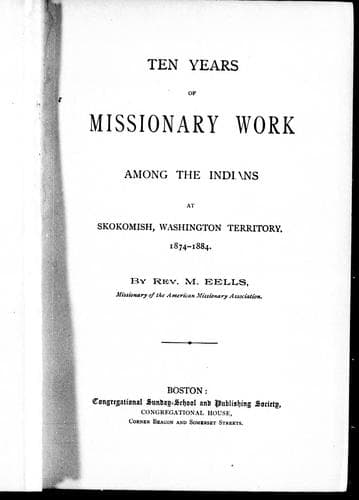
Ten years of missionary work among the Indians at Skokomish, Washington Territory, 1874-1884Eells, Myron
Religion
Ten years of missionary work among the Indians at Skokomish, Washington Territory, 1874-1884
Eells, Myron
Clallam Indians -- Missions; Missions -- Washington (State); Skokomish Indian Reservation (Wash.); Twana Indians -- Missions
The Clallam prayer-meetings at Jamestown have been different. They began
them when I visited them only once in six months, hence they had to take
part or give them up. They were not willing to do the latter, therefore
they have had to do the former. Sometimes eight or ten take part. They
seem to expect that if a person join the church he will take part in the
prayer-meeting, and the children of thirteen or fourteen years of age do
so with the older ones. Thrown on their own resources in this respect,
as well as in others, it has had its advantages.
XXXIX.
INDIAN HYMNS.
Our first singing was in English, as we knew of no hymns in the
languages which the Indians could understand. In the Sabbath-school
prayer-meeting and partly in church we have continued to use them, as
the children understand English, and it is best to train them to use the
language as much as possible. “Pure Gold” and the Gospel Hymns and
Sacred Songs, as used by Messrs. Moody and Sankey, have been in use
among the Indian children for the last twelve years. Two or three of the
simplest English songs which repeat considerably have also been learned
by many of the older Indians, who understand a little of our language,
as: “Come to Jesus!” and “Say, brothers, will you meet us?” Yet all
these did not reach the large share of the older Indians as we wished to
reach them. “What are you doing out here?” “Why do you not go to
Sabbath-school?” were questions which were asked one Sabbath by the wife
of the agent to an Indian who was wandering around outside during that
service. His reply was that as the first part of the exercises and the
singing were in English they were very dry and uninteresting to him.
Only when the time came for singing the Chinook song was he much
interested. That was in 1874, and there was only one such song, which
the agent had made previous to my coming; but the want of them, as
expressed by that Indian, compelled us to make more. The first efforts
were to translate some of our simpler hymns into the Chinook language,
but this we found to be impracticable, with one or two exceptions. The
expressions, syllables, words, and accent did not agree well enough for
it; so we made up some simple sentiment, repeated it two or three times,
fitted it to one of our tunes, and sang it. In the course of time we had
eight or ten Chinook songs. They repeated considerably, because the
older Indians could not read and had to learn them from hearing them,
somewhat after the principle of the negro songs. Major W. H. Boyle
visited us in 1876, and was much interested in this singing. He took
copies of the songs and said he would see if he could not have them
printed on the government press belonging to the War Department, at
Portland, free of expense; but I presume he was not able to have it
done, as I never heard of them again.
Public-domain text, read in full here on John Shaqi.
Reviews
Reviews
No reviews yet
Be the first to share your thoughts on this work.
Elsewhere in the archive
Join the Discussion
Join the discussion
Sign in to leave a comment or review.
Sign InorCreate an account