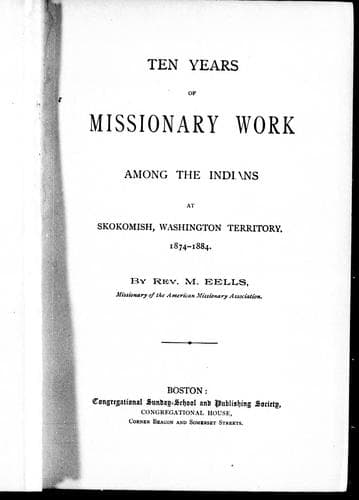
Ten years of missionary work among the Indians at Skokomish, Washington Territory, 1874-1884Eells, Myron
Religion
Ten years of missionary work among the Indians at Skokomish, Washington Territory, 1874-1884
Eells, Myron
Clallam Indians -- Missions; Missions -- Washington (State); Skokomish Indian Reservation (Wash.); Twana Indians -- Missions
In my visits among white people and in other Sabbath-schools I was often
called upon to sing them, and was then often asked for a copy; so often
was this done that I grew tired of copying them. Encouraged by this
demand and by Major Boyle’s interest in them, I thought I would see if I
could not have them published. I wrote to several other reservations,
asking for copies of any such hymns which they might have, hoping that
they also would bear a share of the expense of publishing them; but I
found that most of them had no such songs, and, to my surprise, some
seemed to have no desire for them. So I was compelled to carry on the
little affair alone. I was unable to bear the expense, but fortunately
then Mr. G. H. Himes, of Portland, consented to run all risks of
printing them, and so in 1878 a little pamphlet, entitled “Hymns in the
Chinook Jargon Language,” was printed, and it has been very useful. The
following, from its introductory note, may be of interest:--
“These hymns have grown out of Christian work among the Indians.... The
chief peculiarity which I have noticed in making hymns in this language
is that a large proportion of the words are of two syllables, and a
large majority of these have the accent on the second syllable, which
renders it almost impossible to compose any hymns in long, common, or
short metres.”
The following remarks were made about it by the editor of _The American
Missionary_:--
“It is not a ponderous volume like those in use in our American
churches, with twelve or fifteen hundred hymns, but a modest pamphlet of
thirty pages, containing both the Indian originals and the English
translations. The tunes include, among others, ‘Bounding Billows,’ ‘John
Brown,’ and ‘The Hebrew Children.’ The hymns are very simple and often
repeat all but the first line. The translations show the poverty of the
language to convey religious ideas.... It is no little task to make
hymns out of such poor materials. Let it be understood that these are
only hymns for the transition state--for Indians who can remember a
little and who sing in English as soon as they have learned to read.
This little book is a monument of missionary labor and full of
suggestion as to the manifold difficulties to be encountered in the
attempt to Christianize the Indians of America.”
Since then I have made a few others which have never been printed, one
of which is here given. The cause of it was as follows: One day I asked
an Indian what he thought of the Christian religion and the Bible. His
reply was that it was good, very good, for the white man, but that the
Indian’s religion was the best for him. Hence in this hymn I tried to
teach them that the Bible is not a book for the white people alone, but
for the whole world--an idea which is now quite generally accepted among
them. In all we now have sixteen hymns in Chinook, five in Twana, five
in Clallam, and two in Nisqually.
_Tune_, “Hold the Fort.”
Public-domain text, read in full here on John Shaqi.
Reviews
Reviews
No reviews yet
Be the first to share your thoughts on this work.
Elsewhere in the archive
Join the Discussion
Join the discussion
Sign in to leave a comment or review.
Sign InorCreate an account