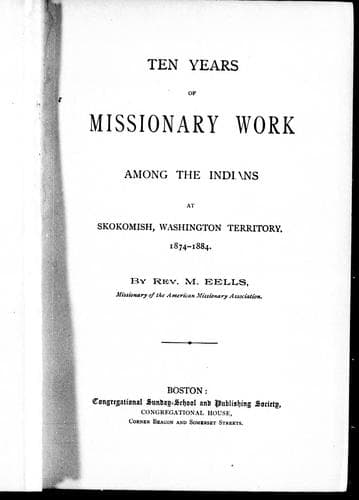
Ten years of missionary work among the Indians at Skokomish, Washington Territory, 1874-1884Eells, Myron
Religion
Ten years of missionary work among the Indians at Skokomish, Washington Territory, 1874-1884
Eells, Myron
Clallam Indians -- Missions; Missions -- Washington (State); Skokomish Indian Reservation (Wash.); Twana Indians -- Missions
“In the school on the Indian reservation where I live twenty-five or
thirty Indian children are taught the English language. At one time a
new boy came who knew how to talk our language somewhat but not very
well. Soon after he came he was at work with the other boys and the
teacher, when, in pronouncing one English word, he did not pronounce it
aright. He was corrected but still did not say it right. Again he was
told how, but still it seemed as if his tongue were too thick; and
again, but he did not get the right twist to it. At last one of the
scholars thought that he was doing it only for fun and that he could
pronounce it correctly if he only would do so, so he said: ‘O boys, it
is not because his tongue is crooked but because his ears are
crooked!’”
Query: Are there not some others who have crooked ears?
What does Paul say? “Five times received I forty stripes save one.”
Well, I have never been treated so, for the people are as kind as can
be. “Shipwrecked”? No, only cast twice on the beach by winds from a
canoe. “A night and a day in the deep”? No, only a whole night and a
part of several others on the mud-flats, waiting for the tide to come.
No danger of drowning there. So I have determined to take more of such
spice if it shall come.
XLIII.
CURRANT JELLY.
There is, however, another side to the picture, more like currant jelly.
The people generally are as kind as they can be. “We will give you the
best we have,” is what is often told me, and they do it. Here is a house
near Jamestown, where I have stopped a week at a time, or nearly that,
once in six months for about six years, and the people will take nothing
for it. For seventy-five miles west of Dunginess is a region where a
man’s company is supposed to pay for his lodgings at any house. I meet a
man, who offers to go home, a half a mile, and get me a dinner, if I
will only accept it. A girl, with whose family I was only slightly
acquainted, stood on the porch one day as I passed, and said: “Mister,
have you been to dinner? You had better stop and have some.” A
hotel-keeper, who had sold whiskey for fifteen years, put me in his best
room, one which he had fitted up for his own private use, and then would
take nothing for it. The Superintendent of the Seabeck Mills, Mr. R.
Holyoke, invited me to go to his house whenever I was in the place, and
would never take any thing for it. It amounted to about four weeks’ time
each year for five or six years, and yet he would hardly allow me to
thank him. Others, too, at the same place, have been very kind. The
steamer _St. Patrick_ for two years and a half always carried myself and
family free, whenever we wished to travel on it, and during that time it
gave us sixty or seventy-five dollars’ worth of fare. Captain J. G.
Baker, of the _Colfax_, said to me, six or seven years ago: “Whenever
you or your family, or an Indian whom you have with you to carry you,
wish to travel where I am going, I will take you free.” He has often
Public-domain text, read in full here on John Shaqi.
Reviews
Reviews
No reviews yet
Be the first to share your thoughts on this work.
Elsewhere in the archive
Join the Discussion
Join the discussion
Sign in to leave a comment or review.
Sign InorCreate an account