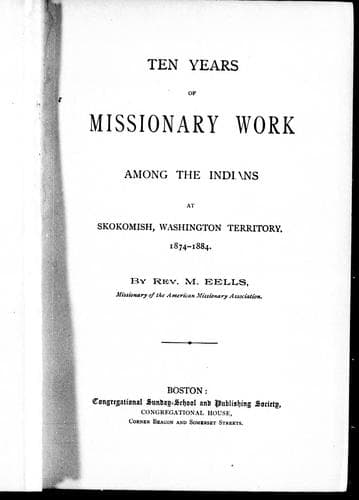
Ten years of missionary work among the Indians at Skokomish, Washington Territory, 1874-1884Eells, Myron
Religion
Ten years of missionary work among the Indians at Skokomish, Washington Territory, 1874-1884
Eells, Myron
Clallam Indians -- Missions; Missions -- Washington (State); Skokomish Indian Reservation (Wash.); Twana Indians -- Missions
done it, sometimes making extra effort with his steamer in order to
accommodate me. The steamers _Gem_ and _McNaught_ also made a rule to
charge me no fare when I traveled on them.
Indians, too, are not wholly devoid of gratitude. It is the time of a
funeral. They are often accustomed at such times to make presents to
their friends who attend and sympathize with them. “Take this money,”
they have often said to me at such times, as they have given me from one
to three dollars. “Do not refuse--it is our custom; for you have come
to comfort us with Christ’s words.” At a great festival, where I was
present to protect them from drunkenness, and other evils equally bad,
they handed me seven dollars and a half, saying, “You have come a long
distance to help us; we can not give you food as we do these Indians, as
you do not eat with us; take this money, it will help to pay your
board.” But when I offered to pay the gentleman with whom I was staying,
Mr. B. G. Hotchkiss, he too would take nothing for the board. The good
people of the Pearl Street Church in Hartford, Connecticut, sent us a
barrel of things in the early spring of 1883, whose money value I
estimated at considerably over a hundred dollars, and whose good cheer
was inestimable in money, because it came when our days were the
darkest.
God has been very good to put it into the hearts of so many people to be
so kind, and not the least good thing that he has done is that he has
put that verse in the Bible about the giving a cup of cold water and the
reward that will follow.
XLIV.
CONCLUSION.
Dr. H. J. Minthorne, superintendent of the Indian Training School at
Forest Grove, Oregon, once remarked to me, “that, in the civilization of
Indians, they often went forward and then backward; but that each time
they went backward it was not quite so far as the previous time, and
that each time they went forward it was an advance on any previous
effort.” I have found the same to be true. They seem to rise much as the
tide does when the waves are rolling--a surge upward and then back; but
careful observation shows that the tide is rising.
There is much of human nature in them. In many respects--as in their
habits of neatness and industry, their visions, superstitions, and the
like--I have often been reminded of what I have read about ignorant
whites in the Southern and Western States fifty years ago, and of what I
have seen among the same class of people in Oregon thirty years ago.
Public-domain text, read in full here on John Shaqi.
Reviews
Reviews
No reviews yet
Be the first to share your thoughts on this work.
Elsewhere in the archive
Join the Discussion
Join the discussion
Sign in to leave a comment or review.
Sign InorCreate an account