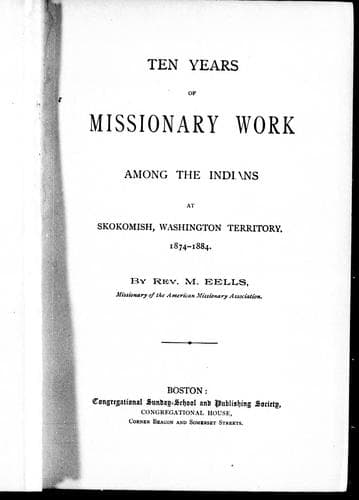
Ten years of missionary work among the Indians at Skokomish, Washington Territory, 1874-1884Eells, Myron
Religion
Ten years of missionary work among the Indians at Skokomish, Washington Territory, 1874-1884
Eells, Myron
Clallam Indians -- Missions; Missions -- Washington (State); Skokomish Indian Reservation (Wash.); Twana Indians -- Missions
A few years previous to the appointment of Agent Eells, in 1871, this
person was made head chief of the Clallams, although, until about 1873,
he could get drunk and fight as well as any Indian. At that time he took
the lead in the progress for civilization near Dunginess, as related in
Chapter V.; and, although once after that, on a Fourth of July, he was
drunk, yet he has steadily worked for the good of his tribe. He has had
a noted name, for an Indian, as an enemy to drunkenness, and his fines
and other punishments on his offending people have been heavy. He gave
more than any other one in the purchase of their land, and, in 1875, it
was named Jamestown in honor of him. He has taken a stand against
potlatches, not even going six miles to attend one when given by those
under him. For a long time he was firm against Indian doctors, though a
few times within about three years he has employed them when he has been
sick, and no white man’s remedies which he could obtain seemed to do
him any good. He was among the first three Indians to begin prayer, a
practice which he kept up several years. But when in 1878 the other two
united with the church, Balch declined to do so, although I had expected
him as much as I had the others. He gave as his excuse that as he was
chief, he would probably do something which would be used as an argument
against religion--an idea I have found quite common among the Indian
officers. In fact, a policeman once asked me if he could be a policeman
and a Christian at the same time. Balch said that whenever he should
cease being chief, he would “jump” into the church. He has continued as
chief until the present time, and his interest in religion has
diminished. At one time he seemed, in the opinion of the school-teacher,
to trust to his morality for salvation. Then he turned to the Indian
doctors, gave up prayer in his house, and now by no means attends church
regularly. Still he takes a kind of fatherly interest in seeing that the
church members walk straight; and the way in which he started and has
upheld civilization, morality, education, and temperance will long be
remembered both by whites and Indians, and its influence will continue
long after he shall die.
XXXIV.
TOURING.
White people have almost universally been very kind to me, the Indians
generally so, but the elements have often been adverse. These have given
variety to my life--not always pleasant, but sufficient to form an item
here and there; and there is nearly always a comical side to most of
these experiences, if we can but see it.
Public-domain text, read in full here on John Shaqi.
Reviews
Reviews
No reviews yet
Be the first to share your thoughts on this work.
Elsewhere in the archive
Join the Discussion
Join the discussion
Sign in to leave a comment or review.
Sign InorCreate an account