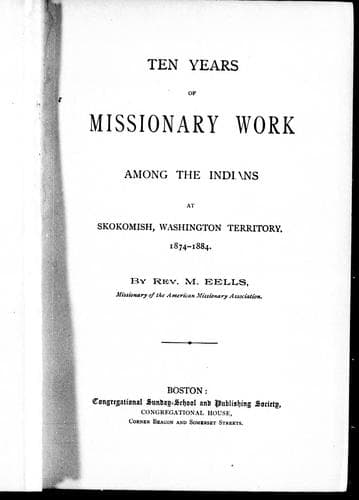
Ten years of missionary work among the Indians at Skokomish, Washington Territory, 1874-1884Eells, Myron
Religion
Ten years of missionary work among the Indians at Skokomish, Washington Territory, 1874-1884
Eells, Myron
Clallam Indians -- Missions; Missions -- Washington (State); Skokomish Indian Reservation (Wash.); Twana Indians -- Missions
One day in February, 1878, I started from Port Gamble for home with
eight canoes, but a strong head-wind arose. The Indians worked hard for
five hours, but traveled only ten miles and nearly all gave out, and we
camped on the beach. It rained also, and the wind blew still stronger so
that the trees were constantly falling near us. I had only a pair of
blankets, an overcoat, and a mat with me, but having obtained another
mat of the Indians, I made a slight roof over me with it and went to
sleep. About two o’clock in the morning I was aroused by the Indians,
when I learned that a very high tide had come and drowned them out. My
bed was on higher ground than theirs, but in fifteen minutes that ground
was three or four inches under water. We waded around, wet and cold, put
our things in the canoes and soon started. There was still some rain and
wind, and it was only by taking turns in rowing that we could keep from
suffering. In four hours we were at Seabeck, where we were made
comfortable, but that was a cold, long, dark, wintry morning ride.
I started from Jamestown for Elkwa, a distance of twenty-five miles, on
horseback, but, after going ten miles, the horse became so lame that he
could go no farther. I could not well procure another, so I proceeded on
foot. Soon I reached Morse Creek, but could find no way of crossing. The
stream was quite swift, having been swollen by recent rains. The best
way seemed to be to ford it. So, after taking off some of my clothes, I
started in. It was only about three feet deep, but so swift that it was
difficult to stand, and cold as a mountain stream in December naturally
is. But with a stick to feel my way, I crossed, and it only remained for
me to get warm, which I soon did by climbing a high hill.
Coming from Elkwa on another trip on horseback, with a friend, we were
obliged to travel on the beach for eight miles, as there was no other
road. The tide was quite high, the wind blowing, and the waves came in
very roughly. There were many trees lying on the beach, around which we
were compelled to canter as fast as we could when the waves were out.
But one time my friend, who was just ahead, passed safely, while I was
caught by the wave which came up to my side, and a part of which went
over my head. It was very fortunate that my horse was not carried off
his feet.
Once I was obliged to stay in one of their houses in the winter, a thing
I have seldom done, unless there is no white man’s house near, even in
the summer, when I have preferred to take my blankets and sleep outside.
The Indians have said that they are afraid the panthers will eat me; but
between the fleas, rats, and smoke (for they often keep their
old-fashioned houses full of smoke all night), sleep is not refreshing,
and the next morning I feel more like a piece of bacon than a minister.
Public-domain text, read in full here on John Shaqi.
Reviews
Reviews
No reviews yet
Be the first to share your thoughts on this work.
Elsewhere in the archive
Join the Discussion
Join the discussion
Sign in to leave a comment or review.
Sign InorCreate an account