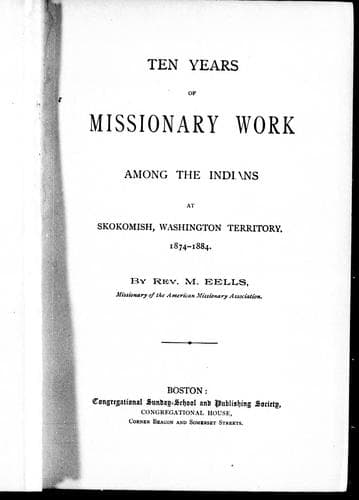
Ten years of missionary work among the Indians at Skokomish, Washington Territory, 1874-1884Eells, Myron
Religion
Ten years of missionary work among the Indians at Skokomish, Washington Territory, 1874-1884
Eells, Myron
Clallam Indians -- Missions; Missions -- Washington (State); Skokomish Indian Reservation (Wash.); Twana Indians -- Missions
At last I came across some large charts, on rollers, highly colored,
published by Haasis & Lubrecht, of New York. They were twenty-eight by
thirty-five inches, and I could sell them for twenty-five cents each,
and they were very popular. They went like hot cakes--were often wanted
faster than I could get them, although I procured from twenty to forty
and sometimes more at once. Protestant and Catholic Indians, Christians
and medicine-men, those off the reservation and on other reservations as
well as at Skokomish, were equally pleased with them, so that I sold
four hundred and fifty in twenty-one months. They were large, showy,
cheap, and good, care being used not to obtain some purely Catholic
pictures which they publish.
“The Story of the Bible,” “Story of the Gospel,” and “First Steps for
Little Feet in Gospel Paths,” also have proved very useful for those who
can read a little but can not understand all the hard words in the
Bible. Their numerous pictures are attractive, and the words are easy to
be understood.
XXXVII.
THE SABBATH-SCHOOL.
From the first a Sabbath-school has been held on the reservation.
Previous to the time when Agent Eells took charge, while Mr. D. B. Ward
and Mr. W. C. Chattin were the school-teachers, they worked in this way.
But there was no Sabbath-school in the region which the Indians had
seen; the white influences on the reservation by no means ran parallel
with their efforts, and it was hard work to accomplish a little. In 1871
Agent Eells threw all his influence in favor of it before there were any
ministers on the reservation or any other Sabbath service, with the
agent as superintendent. After ministers came, it was held soon after
the close of the morning service. The school-children and whites were
expected to be present, as far as was reasonable, and the older Indians
were invited and urged to remain. Sometimes they did and there was a
large Bible class, and sometimes none stayed.
Public-domain text, read in full here on John Shaqi.
Reviews
Reviews
No reviews yet
Be the first to share your thoughts on this work.
Elsewhere in the archive
Join the Discussion
Join the discussion
Sign in to leave a comment or review.
Sign InorCreate an account