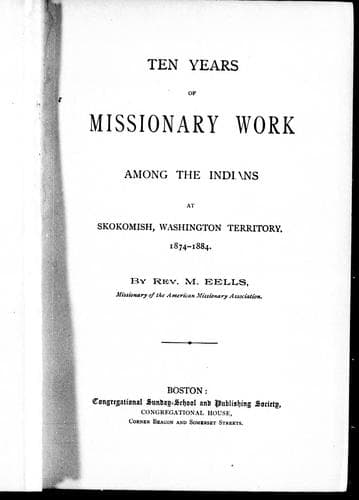
Ten years of missionary work among the Indians at Skokomish, Washington Territory, 1874-1884Eells, Myron
Religion
Ten years of missionary work among the Indians at Skokomish, Washington Territory, 1874-1884
Eells, Myron
Clallam Indians -- Missions; Missions -- Washington (State); Skokomish Indian Reservation (Wash.); Twana Indians -- Missions
A striking feature of the school has been the effort made to induce the
children to learn the lesson. Sometimes they were merely urged to, and
sometimes the agent compelled them so to do, much as if they were his
own children. Six verses have usually been a lesson sometimes all of
them being new ones, and sometimes three being in advance and three in
review. Those who committed them all to memory were placed on the roll
of honor, and those who had them all perfectly received two
credit-marks; so that if there were no interruption on any Sabbath in
the school, 104 was the highest number that any one could obtain. During
1875 the record was kept for fifty Sabbaths, and the highest number of
marks obtained by any of the Indian children was forty-eight, by Andrew
Peterson. Eighty-eight were obtained by each of two white children,
Minnie Lansdale and Lizzie Ward. Twenty of the Indian children were on
the roll of honor some of the time. During 1876 Miss Martha Palmer, an
Indian girl, received eighty-six marks out of a possible hundred. The
next highest was a white girl, then a half-breed girl, then an Indian
boy, and then a white boy. During 1877 the same Martha Palmer received
ninety-six marks, the highest number possible that year, there having
been no school on four Sabbaths. In 1878 Martha Palmer and Emily Atkins
each committed the six verses to memory and recited them perfectly at
the school during forty-nine Sabbaths, there having been no school on
three Sabbaths. That was the best report during the ten years. The
highest number in 1883 was by Annie Sherwood, but the number of
credit-marks was only forty-eight.
Sometimes we followed the simplest part of the Bible through by course
and sometimes used the International Lessons. The former plan was in
many respects better for the scholars, as the International Lessons
skipped about so much that the children often lost the connection; they
were sometimes not adapted for Indians, and the children would lose the
quarterlies or their lesson-papers. The latter plan was for some reasons
better for the teachers, as they could get helps in the quarterlies to
understand the lesson which they could not well get elsewhere.
Sabbath-school papers with a Bible picture in them and an explanation of
it were valuable. Such at last I found in _The Youth’s World_ for 1883.
Once a month, while I had them, I gave the papers to the teachers the
Sabbath previous and told the scholars to learn a few verses in the
Bible about the picture. Then every child received the paper on the
Sabbath, and the story was explained.
Public-domain text, read in full here on John Shaqi.
Reviews
Reviews
No reviews yet
Be the first to share your thoughts on this work.
Elsewhere in the archive
Join the Discussion
Join the discussion
Sign in to leave a comment or review.
Sign InorCreate an account