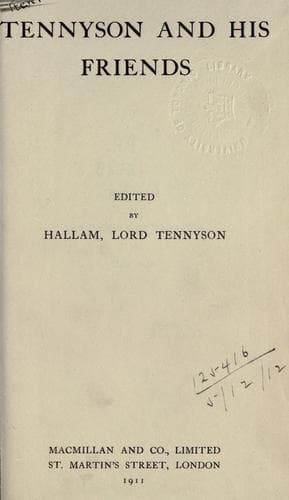
Tennyson, Alfred Tennyson, Baron, 1809-1892 -- Friends and associates
You top the sand-ridge, and below, to right and left, far as eye can see,
stretch the flat, brown sands. Across these the tide, which at the full of
the moon comes right up to the barrier, goes out for three-quarters of a
mile; of this the latter half is left by the shallow wavelets all ribbed,
as you see it on the ripple-marked stone of the Horsham quarries, and
shining with the bright sea-water which reflects the low rays of the sun;
while far off, so far that they seem to be mere toys, the shrimper slowly
drives his small horse and cart, to the tail of which is attached the
primitive purse net, the other end of it being towed by the patient,
long-haired donkey, ridden by a boy whose bare feet dangle in the shallow
wavelets. Farther to the south the tide ebbs quite out of sight. This is
at "Gibraltar Point," near Wainfleet Haven, where Somersby brook at length
finds the sea, a place very familiar to the Poet in his youth. The skin of
mud on the sands makes them shine like burnished copper in the level rays
of the setting sun, which here have no sandbank to intercept them, but at
other times it is a scene of dreary desolation, such as is aptly described
in "The Passing of Arthur":
a coast
Of ever-shifting sand, and far away
The phantom circle of a moaning sea.
It was near this part of the shore that, as a young man, he often walked,
rolling out his lines aloud or murmuring them to himself, a habit which
was also that of Wordsworth, and led in each case to the peasants
supposing the Poet to be "craäzed," and caused the Somersby cook to wonder
"what Mr. Awlfred was always a-praying for," and caused also the
fisherman, whom he met on the sands once at 4 A.M. as he was walking
without hat or coat, and to whom he bid good-morning, to reply, "Thou poor
fool, thou doesn't knaw whether it be night or daä."
But at Mablethorpe the sea does not go out nearly so far, and at high tide
it comes right up to the bank with splendid menacing waves, the memory of
which furnished him, five and thirty years after he had left Lincolnshire
for ever, with the famous simile in "The Last Tournament":
as the crest of some slow-arching wave,
Heard in dead night along that table shore,
Drops flat, and after the great waters break
Whitening for half a league, and thin themselves,
Far over sands marbled with moon and cloud,
From less and less to nothing.
This accurately describes the flat Lincolnshire coast with its
"interminable rollers" breaking on the endless sands, than which waves the
Poet always said that he had never anywhere seen grander, and the clap of
the wave as it fell on the hard sand could be heard across that flat
country for miles. Doubtless this is what prompted the lines in "Locksley
Hall":
Locksley Hall, that in the distance overlooks the sandy tracts,
And the hollow ocean-ridges roaring into cataracts.
Public-domain text, read in full here on John Shaqi.
Reviews
Reviews
No reviews yet
Be the first to share your thoughts on this work.
Join the Discussion
Join the discussion
Sign in to leave a comment or review.
Sign InorCreate an account