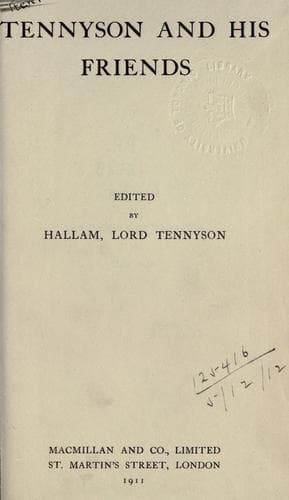
Tennyson, Alfred Tennyson, Baron, 1809-1892 -- Friends and associates
These lines present to the reader the hopefulness of the spiritual mind,
hopefulness not akin to the merely sanguine temperament, but based on a
deep conviction of the reality of the spiritual world, and on unfailing
certainty that there is in it a key to the perplexities of this universe
of which we men understand so little. We know from experience that
material Nature is working out her ends, however little we understand the
process, and however unpromising portions of her work might appear without
this knowledge. That an acorn should have within it forces which compel
earth, air, and water to come to its assistance and become the oak tree,
would seem incredible were it not so habitually known as a fact; and the
certainty which such experiences give in the material order, the eye of
faith gives in the spiritual order. However perplexing the universe now
seems to us we have this deep trust that there _is_ an explanation, and
that when we are in a position to judge the _whole_, instead of looking on
from this corner of time and space, the truth of the spiritual
interpretation of its phenomena will be clear--"ut iustificeris in
sermonibus tuis et vincas cum iudicaris." This view runs not only through
the passages I have just quoted, but through all the poem. The poet pleads
for steadfast trust and hope in the face of difficulty, as we would trust
a known and intimate friend in the face of ominous suspicions.
It is, of course, just that keen realization of the plausibleness of the
sceptical view of life, to which some of our modern critics object as a
sign of weakness, which gives this poem its strength. Such assistance as
Tennyson gives us in seeing and realizing the spiritual view is needed
only or mainly by those to whom agnosticism in its various forms is a
plausible, and, at first sight, a reasonable attitude. The old-fashioned
"irrefragable arguments" are of little use by themselves to persons in
such a condition. However evident spiritual truths may be to an absolutely
purified reason, they are not evident to intellects which are impregnated
with a view of things opposed to the religious view. Moreover, we do not
consult a doctor with much confidence if he does not believe in the
reality of our illness; and one who finds the sceptical view persuasive
will have little trust in those who tell him that it has no plausibility
at all. With Tennyson, as with Cardinal Newman, half the secret of his
influence in this respect is that the sceptically minded reader finds
those very disturbing thoughts which had troubled his own mind anticipated
and stated. And yet a truer and deeper view is likewise depicted, which
sees beyond these thoughts, which detects through the clouds the light in
the heavens beyond.
Public-domain text, read in full here on John Shaqi.
Reviews
Reviews
No reviews yet
Be the first to share your thoughts on this work.
Elsewhere in the archive
Join the Discussion
Join the discussion
Sign in to leave a comment or review.
Sign InorCreate an account