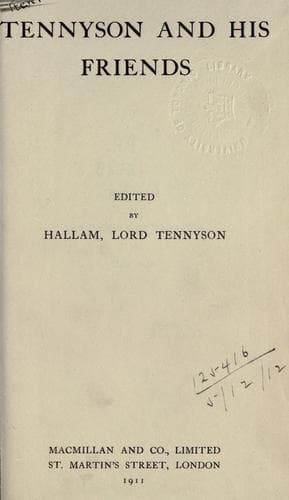
Tennyson, Alfred Tennyson, Baron, 1809-1892 -- Friends and associates
In the "Ancient Sage" there is a striking instance of this characteristic.
The young philosopher, filled with the failure of fair promise and the
collapse of apparent purpose in Nature and in man, pours forth his
sceptical lament. Here is a selection from it, typical of the rest:
The years that made the stripling wise
Undo their work again,
And leave him, blind of heart and eyes,
The last and least of men;
* * * * *
His winter chills him to the root,
He withers marrow and mind;
The kernel of the shrivell'd fruit
Is jutting thro' the rind;
The tiger spasms tear his chest,
The palsy wags his head;
The wife, the sons, who love him best
Would fain that he were dead;
* * * * *
The statesman's brain that sway'd the past
Is feebler than his knees;
The passive sailor wrecks at last
In ever-silent seas;
The warrior hath forgot his arms,
The Learned all his lore;
The changing market frets or charms
The merchant's hope no more;
The prophet's beacon burn'd in vain,
And now is lost in cloud;
The plowman passes, bent with pain,
To mix with what he plow'd;
The poet whom his Age would quote
As heir of endless fame--
He knows not ev'n the book he wrote,
Not even his own name.
For man has overlived his day,
And, darkening in the light,
Scarce feels the senses break away
To mix with ancient Night.
The Sage--far from denying the force of what he says--contends for a
deeper and wider view. The "_darkness is in man_." It is the result of the
incompleteness of his knowledge. That is to say, what is black to his
imperfect view, and taken by itself, may be a necessary part of a great
scheme. Not that the things are not really sad, but that the whole is not
sad. As there may be pain in tears of joy, and yet it is lost in exquisite
pleasure, so the dark elements of life, when our ultimate destiny is
attained and we can view age and suffering as part of the whole, may be so
entirely eclipsed, that we may say with truth that the "world is wholly
fair":
My son, the world is dark with griefs and graves,
So dark that men cry out against the Heavens.
Who knows but that the darkness is in man?
The doors of Night may be the gates of Light;
For wert thou born or blind or deaf, and then
Suddenly heal'd, how would'st thou glory in all
The splendours and the voices of the world!
And we, the poor earth's dying race, and yet
No phantoms, watching from a phantom shore
Await the last and largest sense to make
The phantom walls of this illusion fade,
And show us that the world is wholly fair.
Public-domain text, read in full here on John Shaqi.
Reviews
Reviews
No reviews yet
Be the first to share your thoughts on this work.
Elsewhere in the archive
Join the Discussion
Join the discussion
Sign in to leave a comment or review.
Sign InorCreate an account