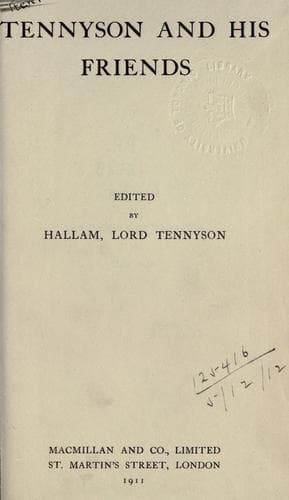
Tennyson, Alfred Tennyson, Baron, 1809-1892 -- Friends and associates
"The doors of night may be the gates of light," says the Sage; and in
unison with this note are his replies to some of the details of the
younger man's wail, while his very argument presupposes that _all_ cannot
now be answered until we have the "last and largest sense." Thus, when the
dreary, hopeless vision of bodily decay, which seems to point to total
dissolution of a noble nature, is referred to, he says:
The shell must break before the bird can fly.
The breaking of the shell might seem, at first sight, total destruction,
but the forthcoming of the bird transforms the conception of decay into a
conception of new birth. And so, too, in answer to the complaint that "the
shaft of scorn that once had stung, but wakes the dotard smile," he
suggests that a more complete view may show it to be "the placid gleam of
sunset after storm." The transition may be not from intense life to
apathy, but from blinding passion to a calmer, a serener vision.
Another of the later poems--"Vastness"--brings into especial relief a
parallel I have often noted between Lord Tennyson and Cardinal Newman in
their keen sense of the mysteries of the universe, which religion helps us
to bear with but does not solve. So far as this planet goes, and our own
human race, Cardinal Newman has expressed this sense in the _Apologia_,
and the parallel between his view and Tennyson's is sufficiently
instructive to make it worth while to quote the passage in full:
To consider the world in its length and breadth, its various history,
the many races of man, their starts, their fortunes, their mutual
alienation, their conflicts; and then their ways, habits, governments,
forms of worship; their enterprises, their aimless courses, their
random achievements and acquirements, the impotent conclusion of
long-standing facts, the tokens so faint and broken of a
superintending design, the blind evolution of what turn out to be
great powers and truths, the progress of things as if from unreasoning
elements, not towards final causes, the greatness and littleness of
man, his far-reaching aims, his short duration, the curtain hung over
his futurity, the disappointments of life, the defeat of good, the
success of evil, physical pain, mental anguish, the prevalence and
intensity of sin, the pervading idolatries, the corruptions, the
dreary hopeless irreligion, that condition of the whole race so
fearfully yet exactly described by the Apostle, "having no hope and
without God in the world," all this is a vision to dizzy and appal;
and inflicts upon the mind the sense of a profound mystery which is
absolutely beyond human solution.
Public-domain text, read in full here on John Shaqi.
Reviews
Reviews
No reviews yet
Be the first to share your thoughts on this work.
Elsewhere in the archive
Join the Discussion
Join the discussion
Sign in to leave a comment or review.
Sign InorCreate an account