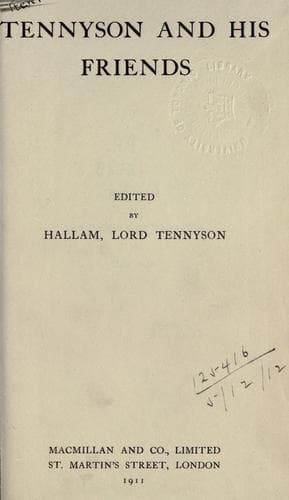
Tennyson, Alfred Tennyson, Baron, 1809-1892 -- Friends and associates
He was fond of telling Lincolnshire stories. _T._ "An old farmer, at the
time when railways were beginning, receiving a visit from the parson,
moved uneasily in his bed, crying out, 'What with faäth, and what with
real bad harvests, and what with them graät, horrid steäm-kettles, and
what with the soön goin' raound the earth, and the earth goin' raound the
soön, as soom saäy she do, I am cleän maäzed an' the sooner I gits out of
this 'ere world, the better;' and he turned his face to the wall and
died."
* * * * *
I close my chapter of fragments and echoes still abiding with me; men
privileged as I was can hear the voice and hate a gramophone. My aim has
been to show the everyday life, the plain unvarnished words which were the
daily change with the first man of his age and a rank-and-file
acquaintance just able, and no more, to appreciate such kindness.
_Haec olim meminisse iuvabit._
MUSIC, TENNYSON, AND JOACHIM
By SIR CHARLES STANFORD
My acquaintance, or rather my friendship, with Alfred Tennyson (for he had
an all-compelling power of making real friends of, and being a true friend
to, those far junior to himself) dated only from 1879, when he was in
years seventy, but in mental vigour the contemporary of the youngest man
he happened to be with. Previously, however, in 1875, I had had experience
of his thoughtful kindness. He had chosen me, an unknown and untried
composer, to write the incidental music to his tragedy of "Queen Mary" for
its production at the Lyceum Theatre, then under the management of Mrs.
Bateman. Many difficulties were put in the way of the performance of the
music, into the causes of which I had neither the wish nor the means to
penetrate. Finally, however, the management gave as an explanation that
the music could not be performed, as the number of orchestral players
required for its proper presentment would necessitate the sacrifice of two
rows of stalls. To my young and disappointed soul came the news of a
generous action which would have been a source of pride to many a composer
of assured position and fame. The Poet had offered, unknown to me, to bear
the expense of the sacrificed seats for many nights, in order to allow my
small share of the work to be heard. The offer was refused, but the
generous action remains--one amongst the thousands of such quiet and
stealthy kindnesses which came as second nature to him, and were probably
as speedily forgotten by himself as they were lastingly remembered by
their recipients.[71]
Public-domain text, read in full here on John Shaqi.
Reviews
Reviews
No reviews yet
Be the first to share your thoughts on this work.
Elsewhere in the archive
Join the Discussion
Join the discussion
Sign in to leave a comment or review.
Sign InorCreate an account