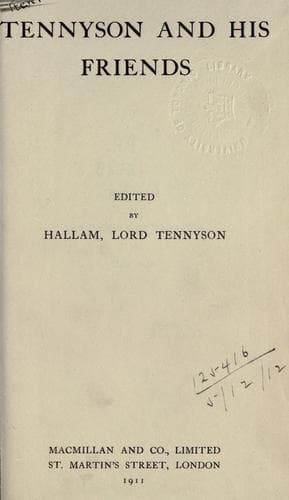
Tennyson, Alfred Tennyson, Baron, 1809-1892 -- Friends and associates
He little knew that, when I was in my early 'teens and had the most
absurdly exaggerated notions of my song-writing powers, I had had the
presumption to ask my cousin, Mr. Stephen Spring Rice, if he would induce
his old friend to send me a MS. poem to set. Happily, I only got a kindly
but necessary rap over the knuckles for my impertinence; the request was
consigned to the waste-paper basket and mercifully never reached
Farringford. I tremble now to recall the incident, although I verily
believe that if Mr. Spring Rice had been cruel enough to send my letter
on, the smile which it must have provoked would in no wise have been a
contemptuous one. I can imagine his saying then, what I have often heard
him say in later days, "Maxima debetur pueris reverentia." I had seen so
much of Aubrey de Vere all through my boyhood that I almost felt as if I
knew Tennyson too, so vivid were his accounts of him, and his descriptions
of his ways and surroundings.
Joachim also, who all through the British part of his international career
was in close touch with the Tennyson circle, used often to speak of him
with the deep reverence and whole-hearted enthusiasm which he reserved for
a very few. On the staircase at Farringford hangs Mrs. Cameron's early
(and still unsurpassed) photograph of the great violinist. My host pointed
at it one day as he passed upstairs: "That's Joachim. He's a fine fellow.
Why did he cover up that fine jowl with a beard?"--quite forgetful of the
possible retort that he had committed the same wickedness himself. On the
comparatively rare occasions when he came up to London, and was surrounded
by all the stars in the literary and political firmament, Joachim and his
Stradivarius were as brilliant a centre of attraction as any of his
guests. Joachim's setting of Merlin's song in "The Coming of Arthur" was
an especial favourite of his, as both in atmosphere and in declamation it
exactly fulfilled the intention of his verse. Joachim once told me that he
always had great hankerings after setting "The Revenge," but that he
repressed them because he felt that it could only be tackled in the true
English spirit by a Britisher.
Public-domain text, read in full here on John Shaqi.
Reviews
Reviews
No reviews yet
Be the first to share your thoughts on this work.
Elsewhere in the archive
Join the Discussion
Join the discussion
Sign in to leave a comment or review.
Sign InorCreate an account