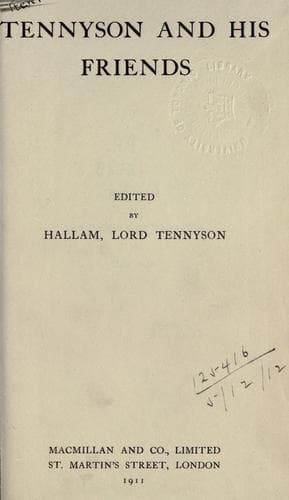
Tennyson, Alfred Tennyson, Baron, 1809-1892 -- Friends and associates
O mein Beschützer, ziehn,
of which he said, "How could Goethe break one's teeth with those z's,
while the rest is so musical?" Curiously enough, it is now known that
Goethe erased "Beschützer" and substituted "Geliebter." He once read to me
from his works for nearly half an hour.
He was extremely particular about clear diction in singing, the lack of
which in the majority of singers of his day was far more marked than it is
nowadays. He intuitively grasped the true basis of that most difficult of
tasks, the composing of a good song which is at once practical and
grateful to sing. He knew that the poem should be the key to the work, and
should be so clearly enunciated that every word can reach the listener;
and that the composer must never over-balance the voice with the
illustrative detail of the accompaniment. When I was setting "The Voyage
of the Mældune" I happened to be at Freshwater; and after finishing the
solo quartet, "The Under-sea Isle," four amateurs sang it through for him.
His only (and I fear very just) comment on the performance was, "I did not
hear a word you said from beginning to end." But he thought afterwards
that we might feel somewhat crushed, and as I was going away some little
time later, and was passing his door, he put his head out and said with a
humorous smile, "I'm afraid I was rather rude just now, but I liked the
way your music rippled away when they fall into the water." This was a
most curious instance of his faculty for recognizing a subtle piece of
musical characterization as rapidly as, and often more rapidly than, a
listener who was fully equipped with musical technique.
Public-domain text, read in full here on John Shaqi.
Reviews
Reviews
No reviews yet
Be the first to share your thoughts on this work.
Elsewhere in the archive
Join the Discussion
Join the discussion
Sign in to leave a comment or review.
Sign InorCreate an account