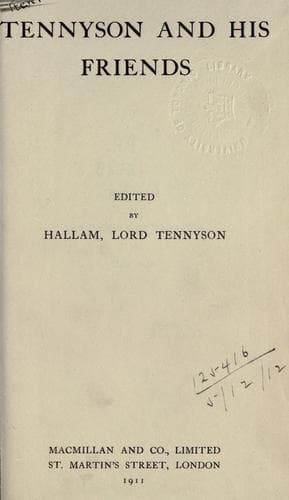
Tennyson, Alfred Tennyson, Baron, 1809-1892 -- Friends and associates
His ear was capable of such fine distinctions of vowel quality, that it
has always been a mystery to me why this gift, so highly developed in him,
did not bring a mastery of music in its train. By one of the odd
dispensations of nature, Robert Browning, who had none of this fineness
of ear, knew enough of music to be able even to read it from a score with
his eyes. Such words as "true" and "too," which in most people's mouths
have an identical vowel sound, were differentiated by him, the "oo" full
and round, the "ue" inclining imperceptibly to "u." His "a" also had far
more varied colours than is usual even with singers. One modification in
especial, the quality of which can best be described as approaching that
of "_Eh_, mon," in broad Scotch, gave a breadth and a dignity to such
words as "Nation," "Lamentation," "Pāgeant" (he never used the horrible
pronunciation "Padgent"), which added vastly to the musical values of his
verse. It is this perfection of vowel balance which makes his poetry so
difficult to set to music satisfactorily. So musical is it in itself that
very little is left for actual music to supply. It is often the very
incompleteness of some poetry which makes it suggestive to a composer, the
qualities lacking in the one calling out for the assistance of the other
to supply them, a condition of combination which Wagner deliberately
carried to a fine art in his double capacity of poet and composer. With
Tennyson there is no gap to fill, and all that music can do is to
illustrate the surrounding atmosphere, and to leave the poetry to tell its
own story with its declamation and inflections accurately preserved.
The best reproduction of the peculiar quality of Tennyson's reading which
I have heard was Irving's rendering of the lines about the bird in the
last act of "Becket":
We came upon
A wild-fowl sitting on her nest, so still,
I reach'd my hand and touch'd; she did not stir;
The snow had frozen round her, and she sat
Stone-dead upon a heap of ice-cold eggs.
The mastery of sound-painting in this line, the chilly "o's" and "e's"
which the Poet knew so well how to place, Irving declaimed with a quiet
reverence which made the sentence so pathetic that it will always live in
the memory of those who heard it. It is interesting to record that all the
actors I have met who witnessed the play invariably hit on those lines as
the high-water mark of Irving's powers.
Public-domain text, read in full here on John Shaqi.
Reviews
Reviews
No reviews yet
Be the first to share your thoughts on this work.
Elsewhere in the archive
Join the Discussion
Join the discussion
Sign in to leave a comment or review.
Sign InorCreate an account