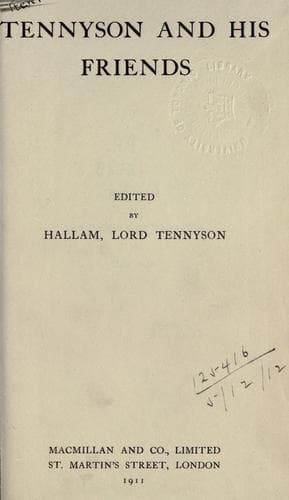
Tennyson, Alfred Tennyson, Baron, 1809-1892 -- Friends and associates
It was from Gunby that Algernon Massingberd disappeared, going to America
and never being heard of again, which gave rise to a romance in "Novel"
form, that came out many years later called _The Lost Sir Massingberd_.
Going on eastward still, by Boothby, where Dr. Tennyson's friends the
Walls family lived, in a house to which you drove up across the grass
pasture, the sheep grazing right up to the front door, a thing still
common in the Lincolnshire Marsh, you come to Burgh, with its magnificent
Church tower and old carved woodwork. Here was the house of Sir George
Crawford, and here from the edge of the high ground on which the Church
stands you plunge down on to the level Marsh across which, at five miles'
distance, is Skegness, at that time only a handful of fishermen's
cottages, with "Hildred's Hotel," one good house occupied by a large
tenant farmer, and a reed-thatched house right on the old Roman sea bank,
built by Miss Walls, only one room thick, so that from the same room she
could see both the sunrise and the sunset. Here all the neighbourhood at
different times would meet, and enjoy the wide prospect of sea and Marsh
and the broad sands and the splendid air. When the tide was out the only
thing to be seen, as far as eye could reach, were the two or three
fishermen, like specks on the edge of the sea, and the only sounds were
the piping of the various sea-birds, stints, curlews, and the like, as
they flew along the creeks or over the gray sand-dunes. Mablethorpe was
nearer to Somersby, but had no house of any size at which, as here, the
dwellers on the wold knew that they were always welcome.
But we have other houses to visit, so let us return by Burgh and Bratoft,
where above the chancel arch of the ugly brick Church is a remarkable
picture of the Spanish Armada, represented as a huge red dragon, with the
ships of Effingham's fleet painted in the corner of the picture.
Passing Bratoft, the next thing we come to is the Somersby brook, which
is here "the Halton River," and on the greensand ridge, overlooking the
fen as far as "Boston Stump," stands the fine Church of Halton Holgate. In
this Church, as at Harrington, Alfred as a boy must have seen the old
stone effigy of a Crusader as described in "Locksley Hall Sixty Years
After"
with his feet upon the hound,
Cross'd! for once he sailed the sea to crush the Moslem in his pride.
Public-domain text, read in full here on John Shaqi.
Reviews
Reviews
No reviews yet
Be the first to share your thoughts on this work.
Join the Discussion
Join the discussion
Sign in to leave a comment or review.
Sign InorCreate an account