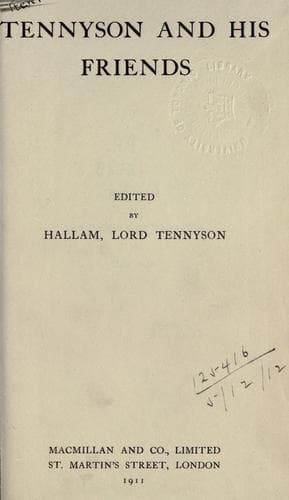
Tennyson, Alfred Tennyson, Baron, 1809-1892 -- Friends and associates
Poets generally must have felt it as a terrible time. What refuge existed
for a poet save to isolate himself from the turmoil, shut himself into his
cabin, and think of other times and other surroundings, away from the
uproar and the gale. Those who did not thus shelter themselves were liable
to bewail the time because the days were evil; as Arnold did, and Clough.
But thus did not Tennyson. Out through the tempest he strode, open-eyed
and bare-headed, with figure erect, glorying in the conflict of the
elements, and summoning the men of his generation to reverence and
worship.
Doubt, yes doubt he justified--doubt, so it were straightforward and
honest. Forms and accessories--these he was willing to let go--though
always with respect and care for the weaker brothers and sisters to whom
they stood for things of value; but Faith beyond those forms he clung to,
faith fearless and triumphant, uprising out of temporary moods of
despondency into ever securer conviction of righteous guidance throughout
creation and far-seeing divine Purpose at the heart of things.
Other men retained their faith too, but many only attained security by
resolutely closing their eyes and bolting the doors of their water-tight
compartments. But the glory of Tennyson's faith was that it never led him
to be unfaithful to the kinds of truth that were being revealed to his
age. That, too, was an age of revelation, and he knew it; the science of
his epoch was true knowledge, as far as it went; it was over-emphatic and
explosive, and to weaker or less inspired minds was full of danger, but it
was genuine cargo, nevertheless, which must be taken on board; there was a
real overload of superstition which had to be discarded; and it was his
mission, and that of a few other noble souls, to help us to accomplish
with calmness and something like wisdom the task of that revolutionary
age.
In the conflict between Science and Faith our business was to accept the
one without rejecting the other: and that he achieved. Never did his
acceptance of the animal ancestry of man, for instance, upset his belief
in the essential divinity of the human soul, its immortality, its
supremacy, its eternal destiny. Never did his recognition of the
materialistic aspect of nature cloud his perception of its spiritual
aspect as supplementing and completing and dominating the mechanism. His
was a voice from other centuries, as it were, sounding through the
nineteenth; and by his strong majestic attitude he saved the faith of
thousands who else would have been overwhelmed; and his writings convey to
our own age a magnificent expression of that which we too have still not
fully accepted, but which we are on the way to believe.
Public-domain text, read in full here on John Shaqi.
Reviews
Reviews
No reviews yet
Be the first to share your thoughts on this work.
Elsewhere in the archive
Join the Discussion
Join the discussion
Sign in to leave a comment or review.
Sign InorCreate an account