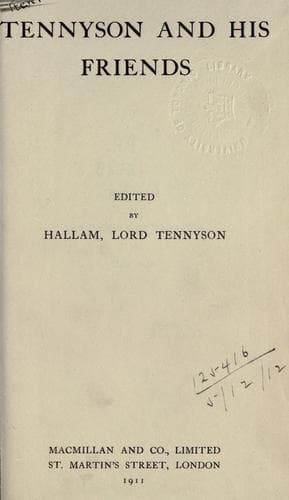
Tennyson, Alfred Tennyson, Baron, 1809-1892 -- Friends and associates
If asked to quote in support of this statement I will not quote more than
the titles of some of the chief poems to which I appeal. Not always the
greatest poems perhaps do I here refer to, but those which most clearly
uphold the contention of the Poet's special service to humanity during the
period of revolution in thought through which mankind has been passing.
Let me instance, therefore, first and most obviously, "In Memoriam"; and
thereafter poems such as "De Profundis," "The Two Voices," "The Ancient
Sage," "Ulysses," "Vastness," "By an Evolutionist," "Demeter and
Persephone," "Akbar's Dream," "God and the Universe," "Flower in the
Crannied Wall," "The Higher Pantheism," "The Voice and the Peak," "Wages,"
and "Morte d'Arthur."
If I do not add to this list the great poem "To Virgil," who in his day
likewise assimilated knowledge of diverse kinds and in the light of
spiritual vision glorified all he touched, it is only because the
atmosphere of the Ancient poet is so like that of the Modern one that it
is not by any single poem that their sympathy and kinship has to be
displayed, but rather by the similarity of their whole attitude to the
Universe.
By the term "Poet of Science" I understand one who assimilates the known
truths of Science and Philosophy, through the pores, so to speak, without
effort and with intuitive accuracy, one who bears them lightly and raises
them above the region of bare fact into the realm of poetry. Such a poet
is one who transfuses fact with beauty, he is ready to accept the
discoveries of his age, no matter how prosaic and lamentable they seem,
and is able to perceive and display the essential beauty and divinity
which runs through them all and threads them all together. That is the
service which a great poet can perform for Science in his day and
generation. The qualities beyond this--exhibited for the most part perhaps
in other poems--which enable him to live for all time, are qualities above
any that I have the right or the power to estimate.
To be overwhelmed and mastered by the material and the mechanical, even to
the extent of being blind to the existence of every other aspect, is
common and human enough. But to recognize to the full the reign of law in
Nature, the sequence of cause and effect, the strength of the chain-armour
of necessity which men of science weave, and yet to discern in it the
living garment of God--that is poetic and divine.
TENNYSON AS A STUDENT AND POET OF NATURE[72]
By SIR NORMAN LOCKYER, F.R.S.
When Tennyson passed from life, not only did England lose one of her
noblest sons, but the world a poet who, beyond all others who have ever
lived, combined the gift of expression with an unceasing interest in the
causes of things and in the working out of Nature's laws.
Public-domain text, read in full here on John Shaqi.
Reviews
Reviews
No reviews yet
Be the first to share your thoughts on this work.
Elsewhere in the archive
Join the Discussion
Join the discussion
Sign in to leave a comment or review.
Sign InorCreate an account