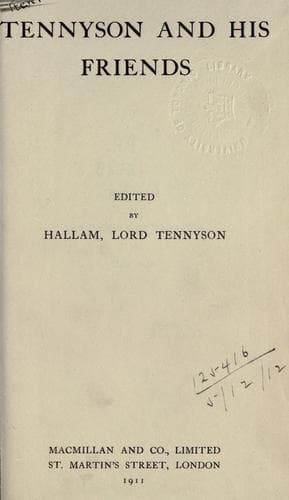
Tennyson, Alfred Tennyson, Baron, 1809-1892 -- Friends and associates
When from this point of view we compare him with his forerunners, Dante is
the only one it is needful to name; but although Dante's knowledge was
well abreast of his time, he lacked the fullness of Tennyson, for the
reason that in his day science was restricted within narrow limits. In
Dante's time, indeed--he was born some 300 years before Galileo and Tycho
Brahe--science apart from cosmogony had chiefly to do with the various
constellations and measurements of the passing of time and the daily and
yearly motions of the sun, for the observation of which long before his
epoch our ancient monuments were erected; the physical and biological
sciences were still unborn. Dante's great work is full of references to
the science of his day; his science and song went hand in hand as
Tennyson's did in later, fuller times. This in strong contrast with such
writers as Goethe who, although both poet and student of science, rarely
commingled the two strands of thought.
It is right and fitting that the highest poetry should be associated with
the highest knowledge. Tennyson's great achievement has been to show us
that in the study of science we have one of the bases of the fullest
poetry, a poetry which appeals at the same time to the deepest emotions
and the highest and broadest intellects of mankind. Tennyson, in short,
has shown that science and poetry, so far from being antagonistic, must
for ever advance side by side.
So far as my memory serves me I was introduced to the late Lord Tennyson
by Woolner about the year 1864. I was then living in Fairfax Road, West
Hampstead, and I had erected my 6-inch Cooke Equatorial in the garden. I
soon found that he was an enthusiastic astronomer, and that few points in
the descriptive part of the subject had escaped him. He was therefore
often in the observatory. Some of his remarks still linger fresh in my
memory. One night when the moon's terminator swept across the broken
ground round Tycho he said, "What a splendid Hell that would make." Again,
after showing him the clusters in Hercules and Perseus he remarked
musingly, "I cannot think much of the county families after that." In 1866
my wife was translating Guillemin's _Le Ciel_ and I was editing and
considerably expanding it; he read many of the proof sheets and indeed
suggested the title of the English edition, _The Heavens_.
In the 'seventies, less so in the 'eighties, he rarely came to London
without discussing some points with me, and in these discussions he showed
himself to be full of knowledge of the discoveries then being made.
Public-domain text, read in full here on John Shaqi.
Reviews
Reviews
No reviews yet
Be the first to share your thoughts on this work.
Elsewhere in the archive
Join the Discussion
Join the discussion
Sign in to leave a comment or review.
Sign InorCreate an account