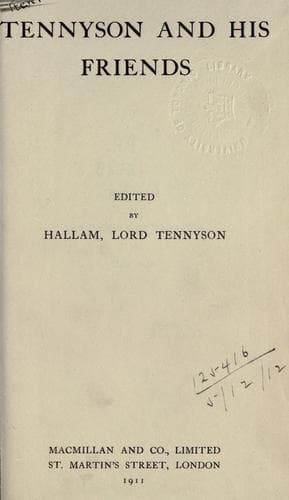
Tennyson, Alfred Tennyson, Baron, 1809-1892 -- Friends and associates
In his view, as it seemed to me, there were two attitudes of mind towards
dogmatic forms--the one impatient of form because form was never adequate
to express the whole truth, the other impatient of form[74] because
impatient of the truth itself. These two attitudes of mind were poles
asunder; they must never be confused together.
I may be allowed to illustrate this discriminating spirit by one or two
reminiscences. I once asked him whether they were right who interpreted
the three ladies who accompanied King Arthur on his last voyage as Faith,
Hope, and Charity. He replied with a touch of (shall I call it?)
intellectual impatience: "They do and they do not. They are those graces,
but they are much more than those. I hate to be tied down to say, 'This
means that,' because the thought in the image is much more than the
definition suggested or any specific interpretation advanced." The truth
was wider than the form, yet the form was a shelter for the truth. It
meant this, but not this only; truth must be able to transcend any form in
which it may be presented.
Hence he could see piety under varying forms: for example, he described
those who were "pious variers from the Church." This phrase, it may here
be related, had a remarkable influence on one man's life, as the following
letter, written by a clergyman who had formerly been a Nonconformist, will
show. The writer died some few years ago; two of his sons are now good and
promising clergymen of the Church of England:
OXFORD VILLAS, GUISELEY, LEEDS,
_January 16, 1901_.
MY LORD BISHOP--In reference to your volume on the Poets, may I
intrude upon your attention one moment to say that it was Tennyson's
phrase in reference to dissenters:
Pious variers from the Church,
in his "Sea Dreams" that first kindled me to earnest thought (some
twenty years since) as to my own position in relationship to the
Church of the land. The force that moved me lay in the word "pious."
Were dissenters more pious than Church people? I regret to say I
thought them much less so; and as this conviction deepened I was
compelled to make the change for which I am every day more
thankful.--I am, my Lord Bishop, your Lordship's devoted servant,
W. HAYWARD ELLIOTT.
Public-domain text, read in full here on John Shaqi.
Reviews
Reviews
No reviews yet
Be the first to share your thoughts on this work.
Elsewhere in the archive
Join the Discussion
Join the discussion
Sign in to leave a comment or review.
Sign InorCreate an account