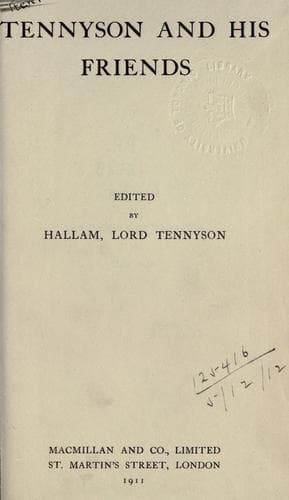
Tennyson, Alfred Tennyson, Baron, 1809-1892 -- Friends and associates
I have already spoken of his recognition of the apparent dualism in
Nature. His outlook on the universe could not ignore the dark and
dismaying facts of existence, and his faith, which rose above the shriek
of Nature, was not based upon arguments derived from any survey of
external, physical Nature. When he confined his outlook to this, he could
see power and mechanism, but he could not from these derive faith. His
vision must go beyond the mere physical universe; he must see life and see
it whole; he must include that which is highest in Nature, even man, and
only then could he find the resting-place of faith. He thus summed up the
matter once when we had been walking up and down the "Ball-room" at
Farringford: "It is hard," he said, "it is hard to believe in God; but it
is harder not to believe. I believe in God, not from what I see in Nature,
but from what I find in man." I took him to mean that the witness of
Nature was only complete when it included all that was in Nature, and that
the effort to draw conclusions from Nature when man, the highest-known
factor in Nature, was excluded, could only lead to mistake. I do not think
he meant, however, that external Nature gave no hints of a superintending
wisdom or even love, for his own writings show, I think, that such hints
had been whispered to him by flower and star; I think he meant that faith
did not find her platform finally secure beneath her feet till she had
taken count of man. In short, he seemed to me to be near to the position
of Thomas Erskine of Linlathen, who said that truth as soon as learned was
felt to be held on a much deeper and more unshakable ground than any
authority which appealed to mere intellect, namely, on its own discerned
truthfulness. The response to all that is highest in Nature is found in
the heart of man, and man cannot deny this highest, because it is latent
in himself already. But I must continue Tennyson's own words: "It is hard
to believe in God, but it is harder not to believe in Him. I don't
believe in His goodness from what I see in Nature. In Nature I see the
mechanician; I believe in His goodness from what I find in my own breast."
I said, "Then you believe that Man is the highest witness of God?"
"Certainly," he replied. I said, "Is not that what Christ said and was? He
was in man the highest witness of God to Man," and I quoted the recorded
words, "He that hath seen Me hath seen the Father." He assented, but said
that there were, of course, difficulties in the idea of a Trinity--the
Three. "But mind," he said, "Son of God is quite right--that He was."[75]
He said that, of course, we must have doctrine, and then he added, "After
all, the greatest thing is Faith." Having said this, he paused, and then
recited with earnest emphasis the lines which sang of faith in the reality
of the Unseen and Spiritual, of a faith, therefore, which can wait the
great disclosure:
Public-domain text, read in full here on John Shaqi.
Reviews
Reviews
No reviews yet
Be the first to share your thoughts on this work.
Elsewhere in the archive
Join the Discussion
Join the discussion
Sign in to leave a comment or review.
Sign InorCreate an account