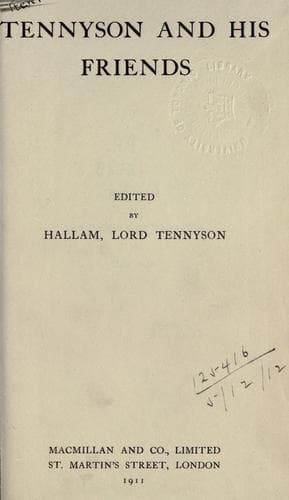
Tennyson, Alfred Tennyson, Baron, 1809-1892 -- Friends and associates
Doubt no longer, that the Highest is the wisest and the best,
Let not all that saddens Nature blight thy hope, or break thy rest,
Quail not at the fiery mountain, at the shipwreck, or the rolling
Thunder, or the rending earthquake, or the famine, or the pest.
Neither mourn if human creeds be lower than the heart's desire;
Thro' the gates that bar the distance comes a gleam of what is higher.
Wait till death has flung them open, when the man will make the Maker
Dark no more with human hatred in the glare of deathless fire.
He was alive to the movements of modern thought. He saw in evolution, if
not a fully proved law, yet a magnificent working hypothesis; he could not
regard it as a theory hostile to ultimate faith; but far beyond the
natural wish to reconcile faith and thought, which he shared with all
right-thinking men, was the conviction of the changeless personal
relationship between God and man. He might find difficulties about faith
and about certain dogmas of faith, such as the Trinity. No doubt, however,
the Poet's conception brought the divine into all human life; it showed
God in touch with us at all epochs of our existence--in our origin, in our
history, in our final self-realization, for He is
Our Father and our Brother and our God.[76]
Religion largely lies in the consciousness of our true relation to Him who
made us; and the yearning for the realization of this consciousness found
constant expression in Tennyson's works and conversation.[77] Perhaps its
clearest expression is to be found in his instructions to his son:
"Remember, I want 'Crossing the Bar' to be always at the end of all my
works."
I hope to see my Pilot face to face
When I have crossed the Bar.
TENNYSON AND SIR JOHN SIMEON, AND TENNYSON'S LAST YEARS
By LOUISA E. WARD[78]
From the misty dawn of early childhood rises the first image of one who
was to fill so large a place in my life and that of those dear to me. As
I, not yet four years old, lay in my father's arms and he said to me the
"Morte d'Arthur," there blended with the picture of the wild winter mere
and the mighty King carried, dying, to its shore, a vision of the man who,
my father told me, lived somewhere amongst us and who could write words
which seemed to me more beautiful than anything I had ever heard.
It was several years before I again came upon the "Morte d'Arthur," when I
was a girl of ten or eleven, and I remember how eagerly I seized upon it,
and how the fairy glamour of my infancy came back to me as I read it.
Public-domain text, read in full here on John Shaqi.
Reviews
Reviews
No reviews yet
Be the first to share your thoughts on this work.
Elsewhere in the archive
Join the Discussion
Join the discussion
Sign in to leave a comment or review.
Sign InorCreate an account