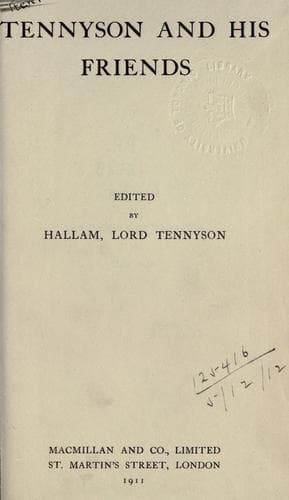
Tennyson, Alfred Tennyson, Baron, 1809-1892 -- Friends and associates
Of his Cambridge life, 1828-30, two main points stand out: the grievous
want he felt of any real stimulus or inspiration in the instruction
provided by the authorities; and, secondly, the remarkable group of
distinguished men of his own age with whom his college life was passed. As
to the first, the scathing lines written at the time, and published with
his express consent in the biography, are more eloquent than any
description could be. After naming all the glories of the Colleges--their
portals, gardens, libraries, chapels, "doctors, proctors and deans"--"all
these," he cries, "shall not avail you when the Daybeam sports, new-risen
over Albion ..." and the poem ends with the reason:
Because your manner sorts
Not with this age wherefrom ye stand apart,
Because the lips of little children preach
Against you,--_you that do profess to teach
And teach us nothing, feeding not the heart_.
On the other hand, this lack (of official wisdom) was more than supplied
by the friends with whom he lived--James Spedding, Monckton Milnes
(afterwards Lord Houghton), Trench, Alford, Brookfield, Blakesley,
Thompson (afterwards Master), Merivale, Stephen Spring-Rice, J. Kemble,
Heath, C. Buller, Monteith, Tennant, and above all Arthur Hallam.
Thirty-five years later Lord Houghton justly said of this group of friends
that "for the wealth of their promise they were a body of men such as this
University has seldom contained." To this should be added the special
influence of the "Apostles," to which Society most of these friends
belonged, who had organized from the first regular weekly meetings for
essays and discussions, where no topic was barred, and speech was
absolutely free. The immense stimulus of such discussion to thought, to
study, to readiness and power of argument, to widening the range of
intellectual interests and literary judgment and appreciation, must be
obvious to all. And we must not forget that the years covered by young
Tennyson's residence at Cambridge were precisely the period of the keenest
intellectual stir and the stormiest political warfare that preceded the
great Reform Bill.
To return to the poetry. Passing over the purely juvenile _Poems by two
Brothers_ printed in his eighteenth year, we have, in 1830, the first book
of poems which have partially survived the mature and fastidious taste
which suppressed so much of the early work. Even here, half the pieces
have been withdrawn, and much of the rest re-written: what remains is
rather slight--the Isabels and Claribels and Adelines and Lilians and
Eleanores, poems which in some critics' views border on the trivial.
Really they should be regarded as experiments in lyric measures: and the
careful student will note the signs of the poet's fine ear and keen eye
for nature: but the depths were not sounded.
Public-domain text, read in full here on John Shaqi.
Reviews
Reviews
No reviews yet
Be the first to share your thoughts on this work.
Elsewhere in the archive
Join the Discussion
Join the discussion
Sign in to leave a comment or review.
Sign InorCreate an account