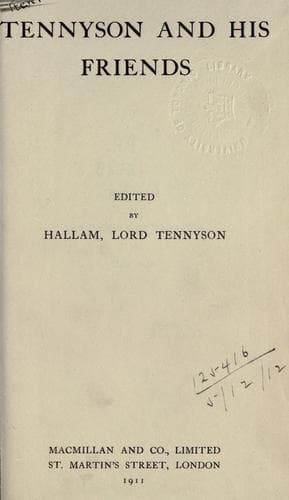
Tennyson, Alfred Tennyson, Baron, 1809-1892 -- Friends and associates
Two years later came the second volume (1832). Again much has been
withdrawn, much re-written: but when in this collection we find
"Œnone," "The Palace of Art," "A Dream of Fair Women," and "The
Lotos-eaters," we see that we have the real poet at last.
"The Palace of Art" is an attempt to trace the Nemesis of selfish culture,
secluding itself from social human life and duty. After three years of
these exclusive delights, the man's outraged nature--or conscience if you
will--reasserts itself in a kind of incipient madness: the soul of him
sees visions. Then a weird passage:
But in dark corners of her palace stood
Uncertain shapes; and unawares
On white-eyed phantasms weeping tears of blood,
And horrible nightmares,
And hollow shades enclosing hearts of flame,
And, with dim fretted foreheads all,
On corpses three-months-old at noon she came,
That stood against the wall.
The horrors, like Gorgons and Furies of ancient poets, are perhaps a
trifle too material; but in the description of the Nemesis there are
touches of real power, which at least are impressive and arresting.
"Œnone" is perhaps the most absolutely beautiful of these early poems,
and for the triumph of melodious sound, and finished picturesqueness of
description, the opening lines are unsurpassed. We should also note that
it took more than one edition to bring it to its present perfection of
form. It is very well known, but no one will object to hear it again:
There lies a vale in Ida, lovelier
Than all the valleys of Ionian hills.
The swimming vapour slopes athwart the glen,
Puts forth an arm, and creeps from pine to pine,
And loiters, slowly drawn. On either hand
The lawns and meadow-ledges midway down
Hang rich in flowers, and far below them roars
The long brook falling thro' the clov'n ravine
In cataract after cataract to the sea.
Behind the valley topmost Gargarus
Stands up and takes the morning: but in front
The gorges, opening wide apart, reveal
Troas and Ilion's column'd citadel,
The crown of Troas.
Before I pass on from "Œnone," I may perhaps add a word or two on
Tennyson's classical poetry generally, and his debt to the great ancient
masterpieces.
Public-domain text, read in full here on John Shaqi.
Reviews
Reviews
No reviews yet
Be the first to share your thoughts on this work.
Elsewhere in the archive
Join the Discussion
Join the discussion
Sign in to leave a comment or review.
Sign InorCreate an account